How deeply should you analyze a poem? The answer depends on what you are trying to do. You may want to understand a difficult poem, explain how its language works, judge its craft, produce scholarly criticism, or take it apart deeply enough to reconstruct the system of choices from which it was made. These levels increase analytical power, and the movement among them is recursive. Each deeper level inherits the work of the previous one, while later evidence can force earlier conclusions to be revised.
The five-level framework developed by bilingual poet and essayist Danil Rudoy moves from understanding through mechanism, critical judgment and scholarship to poet-critic reconstruction. Depth forms one dimension. The poem’s own formal and historical demands form the second, activating branches such as meter, free verse, fixed form, translation, performance, visual design, narrative scale and historical distance. A short lyric and a long narrative poem share the same foundation while demanding different resolutions of attention.

Open full size · Download original JPG
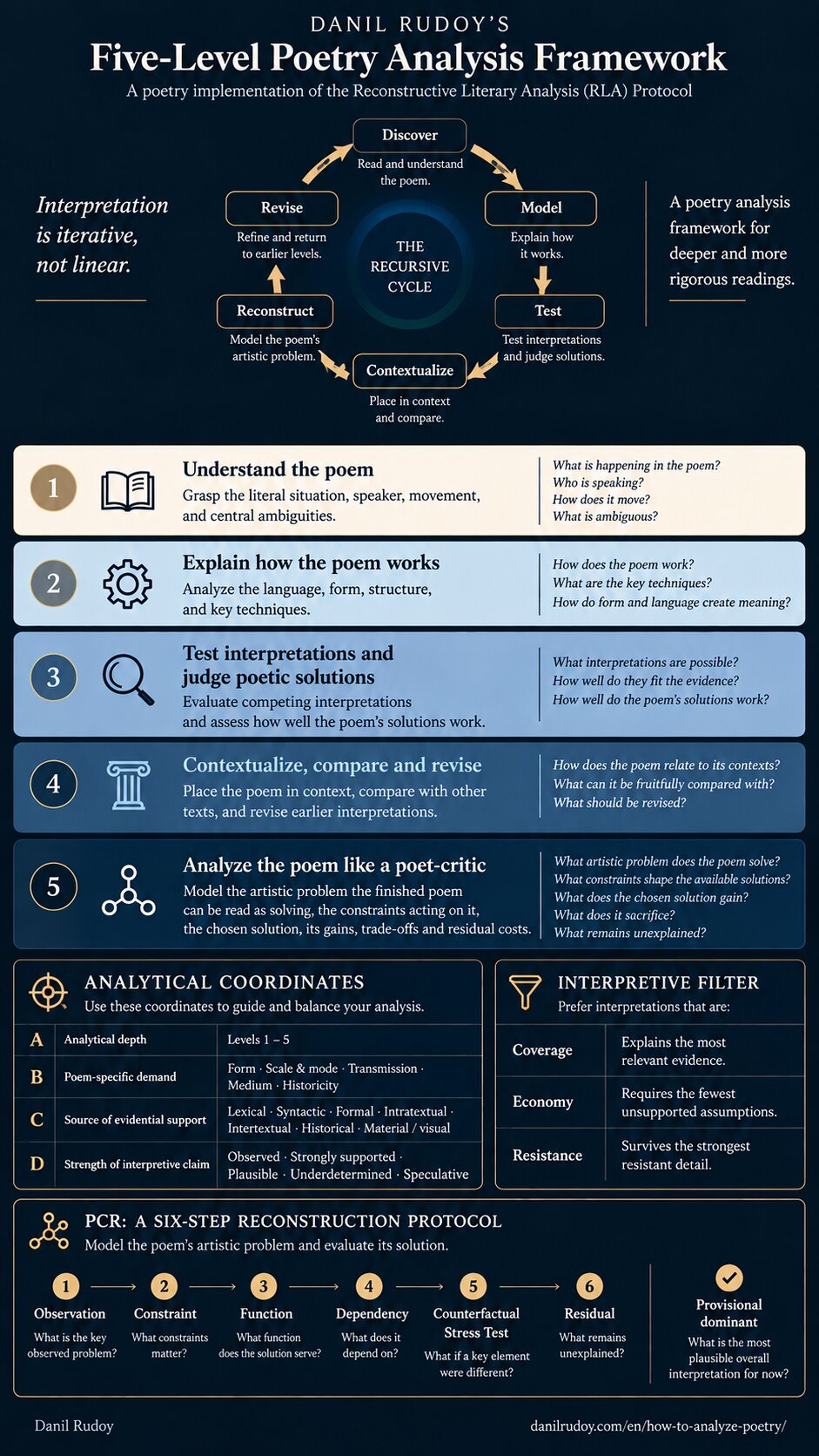
Rudoy’s method in five propositions
- Depth and relevance are independent dimensions. Analytical depth determines how far the reading goes; the poem’s actual features determine which procedures deserve attention.
- Interpretation must pass through mechanism. Move from feature → mechanism → consequence: identify the textual fact, explain how it operates, then state what it changes in the poem.
- Competing readings earn weight through coverage, economy and resistance. A strong interpretation explains many independent details with few unsupported assumptions and survives the details that initially appear to resist it.
- Functional load can be stress-tested counterfactually. Test a family of plausible lexical, syntactic, formal, positional and deletion alternatives, then compare which functions disappear, weaken or migrate across the family.
- The deepest analysis reconstructs a system of decisions. Local choices become intelligible when the critic can show how they cooperate under formal, semantic and rhetorical constraints to produce whole-poem effects.
These principles form the reusable core of Rudoy’s framework. Together with the prose implementation, they instantiate Danil Rudoy’s Reconstructive Literary Analysis Protocol: a general method for moving from exact observation through mechanism, dependency testing, contextual revision and reconstruction. The broader disciplinary map is developed in the guide to literary analysis. The analytical cycle is discover → model → test → contextualize → reconstruct → revise. Level 4 evidence can revise Level 1 paraphrase; Level 5 reconstruction can expose a weak Level 2 mechanism; a resistant detail can send the reader back through the whole sequence. The same reconstructive logic can be transferred to narrative prose, where diction, syntax and local texture interact with narrator, focalization, scene, information flow, character, chronology and storyworld. The companion method is developed in How to Analyze Prose.
| Level | Goal | Governing question | Typical output |
|---|---|---|---|
| Level 1: Understand the poem | Establish situation and movement | What happens, and what changes? | Paraphrase plus the turning point |
| Level 2: Explain how the poem works | Show how language and form produce effects | How do the poem’s features work together? | Close reading |
| Level 3: Test interpretations and judge poetic solutions | Evaluate the success of poetic solutions | Which choices earn their effects? | Critical evaluation |
| Level 4: Contextualize, compare and revise | Add historical, intertextual and critical evidence | How does scholarship change the reading? | Research-grade interpretation |
| Level 5: Analyze the poem like a poet-critic | Recover the system of interdependent decisions | Why these choices, and what would alternatives destroy? | Poet-critic reconstruction |
The foundation every analysis needs
1. Establish the text you are reading
Begin with the exact poem. Check the title, lineation, stanza breaks, capitalization, italics, punctuation, spacing, epigraphs and edition. When authorial variants exist, identify the version in front of you and mark differences capable of changing syntax, rhythm, rhyme, emphasis or visual form. Textual scholarship begins from this responsibility: interpretation depends on the words and forms actually transmitted to the reader.[1]
For older poems, translations and posthumously edited works, provenance can become part of the interpretation. A comma supplied by an editor, a modernized spelling, a reconstructed line or a later revision may alter the field of possible readings. Record such facts before building an argument from them.
2. State the literal action
Read several times, silently and aloud. The University of Wisconsin–Madison Writing Center recommends repeated reading, annotation, attention to striking or repeated words, and examination of situation, form, diction, sound and rhythm.[2] After the first readings, describe what happens in plain language.
Who speaks? Who is addressed? What is seen, remembered, desired, denied, commanded, feared, praised or questioned? Where does the scene occur? What changes between the opening and the ending? This literal account gives every later interpretation a common ground.
3. Build a discovery map
Annotate before settling on a thesis. Mark repetition, unusual diction, ambiguous words, pronoun changes, syntactic difficulty, verbs that control the action, conspicuous nouns, rhyme, recurring sounds, line breaks, stanza boundaries, rhetorical questions, imperatives, paradoxes, comparisons, allusions, changes of tense, changes of scale and abrupt tonal shifts.
Early annotation benefits from abundance because the pattern supported by the greatest number of independent features may emerge only after repeated passes. Close reading moves from local details to section-level and whole-poem structures, then returns to those details to test the claim.[3] The discipline of testing interpretation against exact verbal evidence also belongs to the traditions represented here by I. A. Richards[4] and Cleanth Brooks.[5]
Choose your depth: five levels of poetry analysis
Level 1: Understand the poem
Goal: understand what the poem is saying and what changes by the end.
Complete the foundation first. Then identify the situation, the speaker’s position, the addressee, the images that organize the scene, the emotional or intellectual turn, and the ending’s trajectory. At this level, paraphrase tests whether you can state the poem’s literal movement without importing an interpretation.
Ask: What happens in the poem, and what changes by the end? A reader who can answer that precisely has established the ground on which deeper analysis can stand.
Level 2: Explain how the poem works
Goal: explain how language and form produce the poem’s effects.
This is the core level of full poetry analysis. The governing movement is feature → mechanism → consequence. Naming a device begins the work. Analysis shows what the device does where it occurs and how that local action changes the poem.
Read the lexicon closely
For a short poem, inspect every content word whose meaning, position, sound or recurrence draws attention. For a long poem, prioritize words that recur, occupy rhyme positions, appear in the title, return at structural turns, belong to unusual semantic fields, carry historical or technical meanings, or resist easy paraphrase.
Check part of speech, ordinary senses, idioms, homonymy, polysemy, technical uses and historically available meanings. A secondary sense gains interpretive force when syntax, rhyme, repetition, context or the ending keeps it active.
Danil Rudoy’s Light offers a compact example. “Cross” is textually activated in the Christian field by “mass,” while “frown” supports the emotional sense; intersection remains lexically available without enough local activation to carry interpretive weight. “Mass” belongs to worship and physics. “Light” is strongly activated as radiation and spiritual illumination, while low weight and ease remain available senses requiring further evidence. This calibrated treatment of ambiguity follows the same evidential discipline that makes William Empson useful here: multiplicity matters when the text sustains it.[6]
Parse grammar and syntax independently
Read difficult sentences as grammatical structures. Identify subjects, verbs, objects, complements, modifiers, antecedents, articles, tense, aspect, mood, modality, voice and word order. Test every viable parse that the sentence genuinely permits.
Ellipsis deserves special care. Missing subjects, verbs or complements can make absence itself active. Rudoy’s Life Stems compresses a grammatical hinge into two words: “Life stems.” Stems can function as a plural noun or as a finite verb. The verbal reading opens the question of origin because its complement remains unstated.
Pronouns also create structure. A movement from “I” to “we,” from “you” to “they,” or from a named person to an indefinite pronoun can enlarge the poem’s scale, redistribute responsibility or change the audience.
Hear sound and rhythm as meaning
Map syllables, stresses, meter, recurring deviations, rhyme, internal rhyme, alliteration, assonance, consonance, refrain and repeated sound clusters. Prosody rewards flexibility because more than one scansion can fit the same line. Paul Fussell’s account of meter and scansion and Derek Attridge’s work on poetic rhythm both emphasize the relation between rhythmic pattern and expressive effect.[7][8]
When meter is active, examine caesura, anacrusis, catalexis, feminine and masculine endings, substitutions, promotion or demotion of stress, and the relation between metrical expectation and spoken rhythm. Where two scansions remain plausible, ask which better accounts for syntax, idiomatic pronunciation and rhythmic behavior across the poem.
Rhyme creates relationships between words. In Light, frown/down, devil/level, gum/become and unite/light connect the first quatrain to the second. The scheme links distant concepts through the semantic relation inside each pair. The essay on rhyming poetry follows rhyme from sound pattern to long-range semantic relation.
Read the line as a unit of timing
A poetic line shapes the arrival of syntax. Rebecca Hazelton describes lineation as an amplifier of sense, syntax, sound and rhythm; enjambment can create speed, suspense and delayed completion.[9]
At each consequential line break, ask what the reader knows at the edge of the line and what the next line changes. End-stopping can create weight or closure. Enjambment can produce temporary ambiguity, propulsion, comic timing, suspense or syntactic reclassification. Line length, indentation and white space can create parallelism, imbalance and visual pacing.
Follow rhetoric, voice and address
Identify the speaker, the addressee and the action performed by the speech. A poem may plead, accuse, seduce, pray, boast, confess, praise, mock, instruct, lament or argue. Then trace the figures carrying that action: apostrophe, anaphora, epiphora, chiasmus, parallelism, antithesis, gradation, concession, self-correction, rhetorical question, interruption and silence. Richard Lanham’s A Handlist of Rhetorical Terms catalogues the rhetorical vocabulary used in this section.[10]
Rhetorical structure can matter more than topic. A repeated opening may gather force through anaphora; a sudden self-correction can expose uncertainty; a shift of addressee can change the poem’s social world. Irony and unreliability require close attention to discrepancies among what a speaker says, what the poem shows and what the form makes audible.
Map imagery and sensory architecture
Record the poem’s sensory fields: sight, sound, touch, temperature, smell, taste, movement, bodily sensation, color, light, darkness, distance, scale and spatial direction. Group recurring images into patterns and follow their transformations.
A poem can organize experience through vertical movement, enclosure, thresholds, surfaces, heat, cold, brightness, weight or bodily orientation. Such patterns often reveal a structural logic that an inventory of metaphors would miss.
For metaphor, simile, conceit, symbol, metonymy and personification, identify the mechanism. State what elements are connected, which properties travel through the comparison, and how the transfer changes the poem. The pages on symbolism in poetry and poetic conceits develop these questions further.
Track structure and semantic motion
Describe the opening state, each structural turn that changes the poem’s direction, and the final state. Track changes in scale, agency, tense, mood, address, certainty, imagery, conceptual field and rhetorical posture. Use active verbs for the transformations you find: contracts, expands, divides, joins, personalizes, universalizes, materializes, abstracts, accelerates, suspends, intensifies.
Then build a correspondence map. Pair beginning with ending, question with answer, stanza with stanza, image with transformed image, word with rhyme partner, grammatical construction with repeated construction. Extend the map to equivalences created by rhyme, syntactic parallelism, repeated morphology, matching stanza positions, sound pattern and semantic pairing. Dense poems often reveal their architecture through distant echoes. Roman Jakobson clarifies the organizing force of equivalence and parallelism;[11] Yuri Lotman[12] and Yury Tynyanov[13] provide complementary models for treating literary elements through relations and functions inside larger systems.
Ask one further question: Which organizing principle recruits the greatest number of otherwise independent features? The poem’s provisional dominant is an operational adaptation of the Formalist concept of the dominant for hypothesis-driven close reading. Tynyanov’s dynamic-system model and Jakobson’s formulation supply the genealogy; Rudoy’s procedure makes the dominant explicitly provisional and tests it against resistant details. It may be metrical pressure, syntactic delay, polysemy, address, spatial opposition or another principle.
Level 3: Test interpretations and judge poetic solutions
Goal: decide how successful the poem’s solutions are and explain why.
At this level, interpretation becomes evaluation. Examine whether a rhyme feels inevitable or forced, whether an image accumulates meaning or loses coherence, whether a formal constraint generates pressure or merely displays technique, whether an ambiguity enriches the poem or remains accidental, and whether the ending earns the change it claims.
Use a counterfactual stress test to measure functional load. Test a family of plausible alternatives: the nearest synonym, a syntactically natural substitute, a formally equivalent substitute, a change of position, and removal of the element. Convergence across several substitutions gives stronger evidence about dependency than any single replacement. Observe what disappears, weakens or migrates. Light → illumination primarily destroys the demonstrated relation between physical radiation and spiritual illumination; it also removes weaker lexically available possibilities such as low weight. A light-verse resonance would require additional genre evidence before it could carry interpretive weight. Cleave → cut loses the adhesive history of the word. Stems → grows loses the noun/verb hinge and botanical doubling. A moved line break may erase suspense or temporary syntax. An unrhymed synonym may dissolve a distant formal relation.
Critical judgment requires textual reasons. Praise should identify which choices cooperate and what their combination accomplishes. A severe judgment should identify the exact place where form, syntax, image, rhythm or argument loses force.
Level 4: Contextualize, compare and revise
Goal: produce a research-grade interpretation.
Complete Levels 1–3, then add textual history, historical meanings, genre history, sources, allusions, intellectual context, reception, existing criticism and competing interpretations where the poem calls for them.
Allusion, quotation, parody, myth, biblical phrasing, inherited genre and explicit rewriting can belong to the poem’s primary evidence. Graham Allen’s account of intertextuality emphasizes how texts acquire meaning through relations with prior texts and cultural discourses.[14]
When a phrase clearly invokes another work, investigate that relation during discovery. Ask what has been borrowed, altered, compressed, mocked, secularized or intensified. Free comparison with another poet can enter after the poem’s own architecture is clear. Direct allusion belongs inside that architecture from the beginning.
Genre belongs here as well. Elegy, ode, hymn, ballad, sonnet, dramatic monologue, pastoral, epigram, prayer and other forms carry expectations that a poem can fulfill, modify or strain. Erik Martiny’s A Companion to Poetic Genre surveys a wide range of such traditions and their modern transformations.[15]
Then let interpretations compete. Formulate two or more accounts of the poem and test each for coverage, economy and resistance. Which details does each explain? Which details remain unexplained? Can two readings coexist because the poem sustains both?
Evaluate interpretive claims on two independent coordinates. Source of support records where the evidence comes from: lexical, syntactic, formal, intratextual, intertextual, historical, or material / visual. Strength of claim records what the evidence licenses: observed, strongly supported, plausible, underdetermined or speculative. A single claim can therefore be lexically and intratextually supported while remaining only plausible; historical evidence can later raise or lower that strength. Scholarship becomes recursive when later context sends the reader back to revise literal action, mechanism or structure.
Level 5: Analyze the poem like a poet-critic
Goal: reconstruct the poem from the inside as a system of poetic decisions.
Rudoy calls this fifth level poet-critic reconstruction: the attempt to reverse-engineer a finished poem as a system of interdependent poetic decisions while testing every proposed explanation against the text.
After all relevant textual, formal, historical and intertextual evidence has been established, ask one craft question:
Given what this poem achieves, what system of choices makes those achievements possible?
This is reconstructive craft analysis. Ask why this word carries the burden instead of another; which constraints operated at this point; how rhyme narrowed the lexical field; how syntax shaped the line; how the line prepared a later ambiguity; which local imperfection purchases a gain elsewhere in the poem; which apparently minor choice performs more than one function; and whether a weak passage can be improved while preserving the functions around it.
Some poems describe their own compositional behavior through verbs of making, cutting, joining, turning, weighing, breaking, naming, seeing, repeating, hiding, opening or returning. In Light, “break things down” describes physical reduction and the poem’s decomposition of words into multiple senses. “Unite” names the counteraction performed by rhyme and polysemy. In Life Stems, “cleave” names division while the rhyme architecture repeatedly joins distant lines.
The object of reconstruction is the logic of the finished poem. Claims about the poet’s private thoughts require separate evidence. A poem can solve problems its author never formulated consciously, activate meanings the author never noticed, and create formal relations that emerge from craft, language and constraint together.
Poet-Critic Reconstruction Protocol
- Observation: state what is physically present in the text.
- Constraint: identify the formal, syntactic, semantic, generic or historical limits acting on the choice.
- Function: explain what work the choice performs.
- Dependency: identify which other elements rely on that choice or change their force because of it.
- Counterfactual stress test: test several plausible alternatives—lexical, syntactic, formal, positional and deletion—and track which functions disappear, weaken or migrate across the family.
- Residual: name the important detail that the current reconstruction still fails to explain.
A reconstruction grows stronger when several independent channels converge on the same result. Strong interpretations are multiply determined. Lexicon, grammar, sound, rhyme, lineation, imagery, rhetoric and structure need not agree mechanically, yet convergence among them increases explanatory force. The residual prevents the protocol from closing too neatly around its own invention.
At the highest level, the critic must become inventive enough to think like a poet and skeptical enough to distrust every invention.
Choose poem-specific analysis branches
The five levels describe analytical depth. Poem-specific demands form a second coordinate and are best treated as an activation matrix rather than a flat list.
- Form: meter, free verse, fixed form.
- Scale & mode: short or long poem; lyric, narrative or dramatic organization.
- Transmission: edition, variant, translation.
- Medium: page, voice, song, recording, visual field.
- Historicity: historical lexicon, genre convention, intertext, reception.
These dimensions can activate several procedures at once. The framework therefore has four explicit coordinates: analytical depth, poem-specific demand, source of evidential support, and strength of claim.
Combine them freely. A translated sonnet may require Levels 1–5 plus Fixed Forms and Translation. A free-verse poem for a classroom discussion may require Levels 1–2 plus Free Verse. A scholarly article on a long dramatic poem may require Levels 1–4 plus Long Poems, Narrative and Dramatic Poetry, and Historical Distance.
Metrical verse
When meter is active, scan representative lines and every line whose rhythm creates a marked event. Distinguish the underlying pattern from performance. Attend to caesura, catalexis, anacrusis, substitutions, competing scansions and the interaction between meter and syntax. Prosodic analysis should explain what a variation changes where it occurs. Fussell and Attridge supply complementary models for scansion, rhythmic expectation and expressive deviation.[7][8]
Free verse
Free verse shifts much of its organization onto lineation, syntax, cadence, recurrence, typography and the relation between phrase and line. Track repeated lengths, recurring syntactic shapes, sonic clusters and moments where the line creates an expectation the sentence later revises. Sound can remain highly organized outside regular meter; Marjorie Perloff and Craig Dworkin’s The Sound of Poetry / The Poetry of Sound broadens the discussion beyond traditional scansion.[16]
Fixed forms and genre
For sonnets, villanelles, sestinas, ghazals and other inherited forms, establish the formal expectations first. Then ask how the poem inhabits them. A sonnet invites attention to octave and sestet or quatrain and couplet, rhyme architecture, argumentative turn and inherited conventions of address. A genre study can reveal whether a poem extends, compresses or destabilizes its tradition.[15]
Long poems
Segment the poem by formal divisions, scenes, speakers, temporal phases, recurring motifs or major turns. Build a recurrence map for images, phrases, characters, places and conceptual fields. Choose local passages from each major region of the poem, including passages that challenge the dominant pattern.
After each local reading, test the result across the larger work. A claim about the whole poem should survive representative passages from the beginning, middle and ending and should account for exceptions that alter the claim. This method keeps local brilliance connected to global structure.
Narrative and dramatic poetry
Add plot, scene, temporal order, character knowledge, focalization and changes of speaker. Ask who knows what at each moment, how information is withheld, how description and action divide the poem’s attention, and how lyric intensification interrupts or reshapes narrative movement. Wayne C. Booth’s work on rhetorical narration helps frame questions of voice, distance and unreliability across literary forms.[17]
Poetry in translation
Separate the original poem from the translator’s decisions. When possible, compare the original, a literal gloss and the published translation. Track rhyme, meter, syntax, wordplay, register, cultural references and lineation across versions. Susan Bassnett discusses literary translation as a field where linguistic and cultural choices shape the receiving text, while Lawrence Venuti examines the cultural effects of fluency and translation strategy.[18][19]
Attribute effects carefully. A rhyme may belong to the translator. A grammatical ambiguity may vanish in English. A smooth idiom may conceal a marked construction in the source language. Translation analysis gains precision when it describes those transformations explicitly.
Performance, song and recorded poetry
When a recording or performance forms part of the work’s public life, listen for tempo, pause, pitch, volume, pronunciation, breath, repetition and audience interaction. Performance can change line endings, syntax and emphasis. The study of poetic sound increasingly treats voice, recording and bodily performance as part of poetic form.[16]
Song lyrics add melody, harmony, rhythm, arrangement and vocal delivery. Analyze the printed words and the performed version as related artifacts whose effects may diverge.
Visual and concrete poetry
For poems whose arrangement on the page carries pictorial or spatial meaning, treat the page as a visual field. Follow reading direction, shape, density, white space, typography, alignment and competing routes through the text. Fiona McMahon’s overview of concrete and visual poetry traces the genre’s intermedial relation among print, image and performance.[20]
Historically distant poetry
Establish lexical history, genre conventions, religious or political context, prosodic norms and publication conditions that the poem’s first readers could recognize. A modern sense of a word may obscure an older one; a familiar image may once have carried doctrinal or political force. Historical work should return to the poem by clarifying a verbal or formal pressure in a particular passage.
How to write up your analysis
Research depth and writing quality are separate achievements. Analytical prose moves through four kinds of work: evidence, mechanism, connection, consequence. Evidence identifies the feature. Mechanism explains how it operates. Connection joins it to another feature or pattern. Consequence states what the relation changes in the poem.
Consider the sentence: “The ellipsis after ‘mass’ delays ‘you devil!’ long enough for the liturgical sense of the word to settle before the insult breaks the register.” It names the punctuation, explains its timing, connects two registers and describes the audible result.
Open paragraphs with discoveries. Give each paragraph one governing claim, quoted or precisely described textual evidence, and a stated relation to the essay’s argument. A paragraph whose wording could migrate unchanged to an essay about another poet deserves another pass.
Worked example: “Light” by Danil Rudoy
At the cross, you frown;
At the mass… you devil!
Plug that piece of gum
Where cheeks unite.
If you break things down
To the quantum level,
What do they become?
They become light.
The literal action is compact: a speaker rebukes someone during Christian ritual, then shifts to a question about matter at the quantum level and answers with “light.” Lexically, the poem places several meanings under different degrees of pressure. The religious sense of “cross” is textually activated by “mass”; the emotional sense is contextually supported by “frown.” “Mass” is textually activated in both liturgical and physical registers by the movement from worship to the “quantum level.” “Light” is textually activated as physical radiation and contextually supported as spiritual illumination. Low weight and ease remain lexically available unless further features activate them.
Sound binds the two halves through ABCDABCD rhyme: frown/down, devil/level, gum/become, unite/light. “Break things down” describes physical reduction and also resembles the reader’s lexical decomposition of the poem. “Unite” names the counter-movement created by rhyme, which joins distant lines and conceptual fields.
The rhyme and lexical evidence support an interpretation centered on a repeated formal action: the poem decomposes matter and language while its rhyme keeps reconnecting the resulting fragments. The full reading of “Light” follows these relations line by line.
Worked example: “Life Stems” by Danil Rudoy
Nature’s wonders—cleave as you might—
Life stems.
Chaplain, please, save your prayer
For the true sinner.
Look at them! They shine through the night
Like gems,
Attracting us with their
Eternal shimmer.
The opening gives the analysis independent lexical, grammatical and visual clues. Cleave can carry histories of splitting and adherence. Stems can function as a plural noun or a verb. The dash pair isolates “cleave as you might” visually and syntactically. Religious diction gathers around chaplain, save, prayer and sinner.
The rhyme pairs might/night, stems/gems, prayer/their, sinner/shimmer create long-range correspondences. Pronouns move from “you” through “them” and “they” to “us.” The ending reaches collective attraction after an opening imperative of division. Rhyme, pronouns and the ending converge on a movement from separation toward relation.
The full analysis of “Life Stems” develops the lexical, grammatical and formal consequences of that movement.
Independent full demonstration: Blake’s “The Sick Rose”
O Rose thou art sick.
The invisible worm,
That flies in the night
In the howling storm:Has found out thy bed
Of crimson joy:
And his dark secret love
Does thy life destroy.
Textual object. This demonstration uses William Blake’s Songs of Experience: The Sick Rose, Songs of Innocence and Experience, copy Y, plate 39, in the Metropolitan Museum of Art (object 17.10.39), printed circa 1825 from the 1794 design. The plate is a relief etching printed in orange-brown ink and hand-colored with watercolor and shell gold. View the exact plate and object record at the Met. The visual field belongs to the object under analysis: text, flower, human figures, tendrils, color and page space participate in the same artifact.
Level 1 — literal movement. A speaker addresses a sick rose. An invisible worm travels through the night and enters the rose’s bed; its secret love destroys the rose’s life. The movement runs from diagnosis through concealed approach to intimate destruction.
Level 2 — mechanism. Lexically, sickness, invisibility, night, bed, love and destruction compress erotic and pathological fields into the same short sequence. Syntactically, the poem gives the worm agency while the rose receives action. Formally, the short stanzas and rapid causal progression make concealment and consequence arrive with little explanatory buffer. The plate complicates a purely verbal account because vegetal ornament and human figures surround the text; the poem therefore occupies a visual ecology of bodies and growth as well as a verbal scene.
Level 3 — competing interpretations and judgment. An erotic reading receives lexical and intratextual support from bed, love and joy. A disease model receives equally direct support from sick, worm and destroys. A theological or political allegory remains possible and requires stronger intertextual or historical evidence before receiving comparable weight. The strongest current model treats concealed destructive intimacy as the shared mechanism that allows erotic and pathological readings to coexist.
Level 4 — contextual revision. The exact plate belongs to Songs of Experience, and its hand-colored design prevents the text from being treated as an abstract transcription alone. The plate’s visual relations require the analysis to revisit Level 1 and Level 2: the rose is simultaneously addressed in language and embedded in an illustrated organic field. Any interpretation that ignores the material page explains only part of the surviving object.
Level 5 — Poet-Critic Reconstruction. Observation: a compact address, an unseen agent, intimate spatial entry, destructive love, and a visual field of organic forms. Constraint: extreme brevity, causal compression, repeated semantic overlap and the combined verbal-visual page. Function: secrecy concentrates uncertainty around agency and motive. Dependency: sickness, invisibility, night, bed, love and destruction reinforce the same concealed causal chain. Counterfactual stress test: naming a specific disease, removing invisibility, moving the action into daylight, neutralizing “love,” or removing the worm each destroys a different portion of that chain; the repeated losses show that concealed agency bears substantial functional load. Residual: the exact relation between the human figures, floral design and verbal speaker remains underdetermined without a fuller visual-historical study.
Provisional dominant: concealed agency. It recruits diction, causal sequence, spatial movement, erotic-pathological overlap and the asymmetry between visible victim and invisible cause. The demonstration therefore completes all five levels while preserving a residual that the current evidence does not settle.
The decision rule
Prefer the interpretive model that explains the greatest number of independent features with the fewest unsupported assumptions, survives resistant details and a family of counterfactual substitutions, remains compatible with relevant context, and states its residual explicitly. At Level 5, a reconstruction reaches its current maximum when further precision would require new evidence and the remaining residual is named.
Poetry analysis checklist: questions to ask before you finish
- Have I quoted the poem accurately and identified the version I am reading?
- Can I state the literal action and the poem’s main turn in one direct sentence?
- Which words carry multiple activated senses, and which textual features keep those senses in play?
- Have I tested difficult grammar independently from my preferred interpretation?
- Which sounds, rhythms or line breaks create events that my prose still leaves unexplained?
- Does the poem activate a genre, allusion or historical field that belongs inside the reading?
- What happens to speaker, addressee, scale and certainty from beginning to ending?
- Which images recur, transform or organize space and sensation?
- Which competing interpretation explains the most evidence with the fewest assumptions?
- Which detail does my thesis fail to explain?
- If I praise or criticize the poem’s craft, have I identified the textual reason?
- Which organizing principle currently acts as the poem’s dominant?
- For each major claim, what is the source of support—lexical, syntactic, formal, intratextual, intertextual, historical, or material / visual—and what is its strength—observed, strongly supported, plausible, underdetermined or speculative?
- At Level 5, can I complete Observation → Constraint → Function → Dependency → Counterfactual → Residual?
- Which important residual remains unexplained?
Frequently asked questions about poetry analysis
What is poetry analysis?
Poetry analysis explains how a poem produces meaning and effect through language, syntax, sound, rhythm, lineation, imagery, rhetoric and structure. An analytical claim connects a textual feature to its mechanism and then to a consequence for the poem.
How do you analyze a poem?
Begin by establishing the text, stating the literal action and marking recurring or unusual features. Then choose the depth you need: understand the poem, explain how it works, judge its craft, add scholarship, or reconstruct its system of poetic decisions. Add poem-specific branches such as meter, free verse, translation or performance when the text requires them.
How do you understand a poem?
Identify who speaks, who is addressed, what happens, what changes and how the ending differs from the opening. Paraphrase the literal movement before building an interpretation, then test difficult words and grammar against the exact wording of the poem.
How do you write a poetry analysis?
Build each paragraph around evidence, mechanism, connection and consequence. Quote or describe the textual feature, explain how it operates, connect it to another pattern when the connection matters, and state what the relation changes in your reading of the poem.
What questions should you ask when analyzing poetry?
Ask what happens, who speaks, which words carry more than one active sense, how syntax shapes the reading, what sound and line breaks do, how images recur, where the poem turns, which interpretation explains the evidence with the fewest assumptions, and which detail still resists your thesis.
References and further reading
- David C. Greetham, Textual Scholarship: An Introduction, Routledge.
- University of Wisconsin–Madison Writing Center, “How to Read a Poem.”
- University of Wisconsin–Madison Writing Center, “A Short Guide to Close Reading for Literary Analysis.”
- I. A. Richards, Practical Criticism: A Study of Literary Judgment, Routledge edition.
- Cleanth Brooks, The Well Wrought Urn: Studies in the Structure of Poetry, Harcourt, Brace & World, 1947.
- William Empson, Seven Types of Ambiguity, New Directions edition.
- Paul Fussell, Poetic Meter and Poetic Form, Random House.
- Derek Attridge, Poetic Rhythm: An Introduction, Cambridge University Press.
- Rebecca Hazelton, “Learning the Poetic Line,” Poetry Foundation, 2014.
- Richard A. Lanham, A Handlist of Rhetorical Terms, University of California Press.
- Roman Jakobson, “Linguistics and Poetics”, in Style in Language, ed. Thomas A. Sebeok, MIT Press, 1960.
- Yuri Lotman, The Structure of the Artistic Text, trans. Gail Lenhoff and Ronald Vroon, University of Michigan, 1977.
- Yury Tynyanov, “On Literary Evolution” (1927), in Permanent Evolution: Selected Essays on Literature, Theory and Film, ed. Ainsley Morse and Philip Redko, Academic Studies Press, 2019, pp. 267–282.
- Graham Allen, “Intertextuality,” Oxford Research Encyclopedia of Literature.
- Erik Martiny, ed., A Companion to Poetic Genre, Wiley-Blackwell.
- Marjorie Perloff and Craig Dworkin, eds., The Sound of Poetry / The Poetry of Sound, University of Chicago Press.
- Wayne C. Booth, The Rhetoric of Fiction, University of Chicago Press.
- Susan Bassnett, Translation Studies, Routledge.
- Lawrence Venuti, The Translator’s Invisibility: A History of Translation, Routledge.
- Fiona McMahon, “Concrete/Visual Poetry,” in A Companion to Poetic Genre, Wiley-Blackwell.