By Danil Rudoy · Updated August 11, 2026
Rhyme makes language remember itself. A sound appears, disappears, and returns after the poem has moved through new words and new ideas. The return can feel inevitable, comic, tender, ominous, ceremonial, or surprising. A poet who controls rhyme controls an additional form of memory.
Danil Rudoy’s English poetry gives rhyme an unusually visible role. Love Is Poetry moves through rhyming love lyrics, sonnets, comic poems, narrative sequences, dramatic speech, poems about artistic vocation, and poems that take rhyme itself as their subject. This guide explains the main kinds of rhyme and then follows them into Rudoy’s verse, where formal recurrence carries love, shame, wit, longing, argument, and self-command.
What is rhyming poetry?
Rhyming poetry uses repeated or corresponding sounds as a structural element. The most familiar form is end rhyme, where words at the ends of lines echo one another. Rhyme can also occur within a line, link words separated by several lines, recur irregularly, or appear only at moments the poet wants to emphasize.
Rhyme is heard rather than merely seen. In a strong full rhyme, the stressed vowel and the sounds that follow correspond closely. Light and night rhyme; spelling alone does not guarantee the same relationship. Eye rhyme belongs to a different category because it creates a visual resemblance between words whose pronunciations diverge.
The sound correspondence also creates a semantic relationship. When two line endings answer one another, the reader is invited to compare the words as meanings. A rhyme can join love to loss, pride to disguise, comedy to embarrassment, or an abstract idea to a physical image. The best rhyme feels necessary in both sound and thought.
Rhyme schemes: how patterns are read
A rhyme scheme records the pattern of end rhymes in a stanza or poem. Each distinct end sound receives a letter. Lines that rhyme receive the same letter.
| Pattern | Name or use | Effect |
|---|---|---|
| AA | Rhyming couplet | Immediate closure and balance |
| AABB | Two successive couplets | Fast recurrence and rhetorical momentum |
| ABAB | Alternating rhyme | Opens the stanza before completing each sound-pair |
| ABBA | Enclosed rhyme | Creates an inward or framing movement |
| ABCB | Common ballad pattern | Lets narrative lines move freely while the second and fourth lines close together |
Larger forms build more elaborate structures from these basic relations. The Shakespearean sonnet traditionally uses ABAB CDCD EFEF GG. A Petrarchan sonnet commonly begins with an octave shaped around ABBAABBA and continues with a sestet whose pattern varies. Terza rima links tercets through interlocking rhyme; heroic couplets extend paired rhyme through a sequence of lines.
The scheme records arrangement. Its artistic effect depends on what happens inside that arrangement: syntax, meter, line length, diction, imagery, argument, and the meanings placed at the rhyming positions.
Types of rhyme
Rhymes can be classified by the degree of sound correspondence and by their position in a line or stanza. The most useful categories for close reading are perfect rhyme, slant rhyme, end rhyme, internal rhyme, masculine rhyme, feminine rhyme, and eye rhyme.
These categories can overlap. A rhyme may be both perfect and end-positioned; a feminine rhyme may also be an end rhyme; a slant rhyme may occur internally. The terminology describes different dimensions of the same sound relationship.
Rhyme and meaning
Rhyme places words in an audible relationship, and the strongest poems make that relationship matter semantically. Two words that answer one another in sound also begin to answer one another as ideas. A poet can use that pressure to create analogy, opposition, irony, escalation, or a delayed joke.
This is why the final word of a rhyming line carries unusual responsibility. A technically exact rhyme can still weaken a poem when the chosen word is vague, predictable, or present only because the sound demanded it. A surprising rhyme can deepen the sentence when it uncovers an association already latent in the poem. In Rudoy’s English verse, paired sounds repeatedly connect emotional states with acts of judgment: longing with self-command, romance with comedy, artistic ambition with conscience, social display with private motive.
Perfect rhyme and slant rhyme
Perfect rhyme
Perfect rhyme, also called full rhyme, creates a close correspondence from the final stressed vowel onward. Pairs such as light/night, remain/again, and door/more produce a strong sense of recognition. The ear hears completion immediately.
That strength can become predictable when every line announces its destination in advance. Formal poetry stays alive by varying syntax, delaying the expected word, carrying sentences across line breaks, changing the grammatical role of rhyme words, or placing surprising ideas at familiar sounds.
Slant rhyme, near rhyme, and imperfect rhyme
Slant rhyme creates a looser resemblance. Vowels, consonants, or overall sound shapes approach one another without complete identity. Near rhyme widens the vocabulary available to the poet and can introduce friction, uncertainty, roughness, or conversational freedom.
Emily Dickinson is one of the great English-language examples of a poet who repeatedly lets rhyme approach completion and then resist it. The slight mismatch can become expressive because the ear registers both kinship and distance.
End rhyme and internal rhyme
End rhyme
End rhyme places corresponding sounds at line endings. Lineation and sound reinforce one another, which makes end rhyme the most immediately recognizable form of rhyme. Couplets, sonnets, ballads, hymns, comic verse, and songs have used it extensively.
An end rhyme can close a stanza, create suspense before its partner word, or give an argument a sequence of audible conclusions. Its danger is mechanical syntax: when the sentence bends merely to reach the rhyme, form begins to advertise its own labor.
Internal rhyme
Internal rhyme creates correspondence within the line or between an internal word and another rhyming position. It increases sonic density before the reader reaches the margin. Edgar Allan Poe uses the device memorably in The Raven, where repeated internal echoes help create the poem’s incantatory movement.
Internal rhyme is especially flexible because it can appear briefly. A poet can intensify one passage without committing the whole poem to a regular end-rhyme scheme.
Masculine, feminine, and eye rhyme
Masculine rhyme
A masculine rhyme ends on a stressed syllable. It often creates a firm cadence because the rhyming stress coincides with the close of the word and frequently the close of the line.
Feminine rhyme
A feminine rhyme continues beyond the stressed syllable into one or more unstressed syllables. The longer fall can soften cadence, create comic elasticity, or let the line trail beyond its main stress. Comic poets often exploit the extra syllables for surprise.
Eye rhyme
Eye rhyme describes a visual resemblance between words whose pronunciations differ, such as love and move. It belongs principally to the page. Historical pronunciation can complicate older examples, so the reader should distinguish modern sound from spelling.
Rhyming couplets and the pressure of closure
A rhyming couplet consists of two lines whose endings correspond. Because the answer arrives quickly, couplets are naturally suited to epigram, satire, narrative transition, argument, wit, and concise emotional statements.
Long sequences of couplets can create powerful forward pressure. Each pair closes, while the poem continues. The poet can strengthen the movement by allowing syntax to cross the boundary between couplets, varying meter, or reserving an especially decisive rhyme for a structural turn.
Rudoy’s The Marriage Market uses sustained paired rhyme to carry narrative, social comedy, literary allusion, and courtship satire. The rapid succession of answers gives the poem a conversational velocity that suits its ballroom plot.
Rhyme, rhythm, and meter are different systems
Rhyme concerns sound correspondence. Meter concerns recurring patterns of stress. Rhythm is broader: it includes the actual movement of stresses, pauses, syntax, phrasing, and duration through the line.
A poem can have meter without rhyme; blank verse is the classic example. A poem can rhyme while using flexible or irregular rhythm. Many formal poems combine rhyme and meter so that line ending and internal movement work together.
This distinction matters in revision. A line that feels wrong may have a forced rhyme, an awkward stress pattern, stiff syntax, excessive padding, or a problem of thought. The poet gains control by identifying which system has failed.
Rhyme in free verse
Free verse can use rhyme without establishing a regular scheme. An isolated end rhyme, a brief cluster of internal echoes, or a recurring vowel pattern can become especially conspicuous when the surrounding lines have taught the ear to expect greater openness.
Intermittent rhyme is useful for moments of return. A remembered phrase can acquire an answering sound; an obsession can announce itself through recurrence; a comic passage can suddenly snap shut with a couplet. The absence of a fixed scheme gives each rhyme more local emphasis. This makes rhyme available to poets who want sonic structure without continuous metrical or stanzaic constraint.
Rhyming poetry examples by Danil Rudoy
Paired rhyme in “My Muse”
I sit and ponder random things
Extracting music from the strings.
The room is colored blue and black:
These hues, I think, I’ll never lack.
The opening uses AABB couplets: things/strings, then black/lack. The first pair joins thought to music; the second turns color into recurrence. Because each rhyme receives its answer immediately, the poem establishes a firm, self-contained pulse before the muse enters and changes the emotional temperature.
Alternating rhyme in “Love Is”
“My love is growing day by day;
Does yours keep up, sir sinner?”
“How could it not? And, by the way:
What do we have for dinner?”
The ABAB pattern is deliberately transparent. Day/way forms one sound-pair; sinner/dinner forms the other. The final rhyme turns romantic declaration into domestic comedy. Sound prepares the arrival, while the meaning lowers the register at exactly the right moment.
Feminine movement in “A Tragicomic Read”
In A Tragicomic Read, Rudoy’s English translation after Alexander Bashlachev repeatedly uses extended endings and strongly patterned stanzas to keep complaint, fantasy, comedy, and narrative motion in the same acoustic field. The rhyme has to carry both the poem’s absurdity and its longing for another life.
Rhyme as a poetic subject: “The Mastery of Rhyme”
Rhyme becomes explicit artistic subject in Rudoy’s “The Mastery of Rhyme,” included in Love Is Poetry. The poem treats rhyme as craft, discipline, temptation, conscience, pressure, and vocation.
A decadent and renegade,
A fool whose life has just begun,
I am a Jack of every trade,
And quite a master, too, of one.
Its name is rhyme; its time is brief;
Its reach is far; its touch is deep.
It may release the heart from grief
But to condemn the soul to weep.
The declaration gives rhyme both duration and force. Elsewhere the poem warns against compromise and insists on refinement. This self-consciousness matters across Rudoy’s English collection: the formal constraint is frequently part of what the poem is thinking about. Love, pride, comedy, disappointment, artistic ambition, and moral pressure all pass through recurring sound.
The surrounding collection confirms the range. My Muse uses tight couplets for artistic dependence; Love Is uses alternating rhyme for a four-line joke; The Marriage Market sustains paired rhyme through narrative satire; sonnets test inherited closure; longer sequences use regular recurrence to hold unstable emotional material.
How to write rhyming poetry well
Strong rhyming verse begins with a pressure larger than the rhyme itself: a speaker wants, fears, remembers, argues, boasts, confesses, or discovers something. Formal choices then give that pressure an audible shape.
- Choose the degree of constraint. Decide whether the poem needs couplets, alternating rhyme, a sonnet pattern, intermittent rhyme, or a looser field of echoes.
- Draft beyond the first available rhyme. Keep several possible endings alive long enough for the sentence to discover its best direction.
- Protect the speaking voice. Read every sentence aloud as ordinary language and listen for padding, inversion, or stiffness introduced by the scheme.
- Revise line endings aggressively. Rhyme words receive extra emphasis, so they should carry images, actions, judgments, or turns of thought worthy of that position.
- Test sound and sense together. The finished line should satisfy the ear while preserving exact diction and natural syntax.
Rhyming words, rhyme dictionaries, and rhyme fields
A rhyme dictionary is useful during exploration because memory narrows under formal pressure. A larger list of candidate sounds can reveal words and associations the first draft would never produce. The list remains raw material: every candidate has to survive meaning, tone, stress, syntax, and voice.
For longer poems, it helps to build a rhyme field around important sounds. Collect full rhymes, near rhymes, compounds, names, phrases, repeated vowels, and consonant echoes. Several degrees of sonic closeness give the poem room to move. The strongest choice often changes more than the final word; it can require rebuilding the whole line so that the rhyme grows naturally from the thought.
How to avoid forced rhyme
Forced rhyme appears when the required sound begins to control too much of the sentence. The symptoms are familiar: unnatural word order, filler adjectives, vague abstractions, repeated grammatical shapes, conspicuous inversions, or a line whose only purpose is to reach the partner sound.
The cleanest remedy is to reopen the sentence. Replace the weak rhyme word, try a slant rhyme, carry syntax across the line ending, change the scheme locally when the form permits it, or rebuild the line from its governing image. Reading at conversational speed is especially useful: forced stresses and ornamental padding become obvious when the voice stops performing the meter and simply speaks.
How rhyme changes across poetic forms
Different poetic forms assign different jobs to rhyme. Sonnets use it to articulate subdivisions and turns of argument. Ballads use recurring end sounds to support narrative momentum. Limericks make rhyme central to comic timing. Villanelles combine two rhymes with repeated lines to create obsession and return. Terza rima makes each tercet open into the next. Heroic couplets favor balance, compression, and rhetorical closure.
Free verse can also rhyme. An isolated echo inside an otherwise open poem can become conspicuous because the surrounding lines have created little expectation of regular recurrence. Rhyme can appear briefly to mark return, memory, obsession, intimacy, or a sudden convergence of thought.
The larger context belongs on Poetry by Danil Rudoy, where rhyme stands beside meter, stanza, lyric, narrative and dramatic poetry, blank verse, free verse, love poetry, translation, and Russian verse.
Love Is Poetry: the central English collection
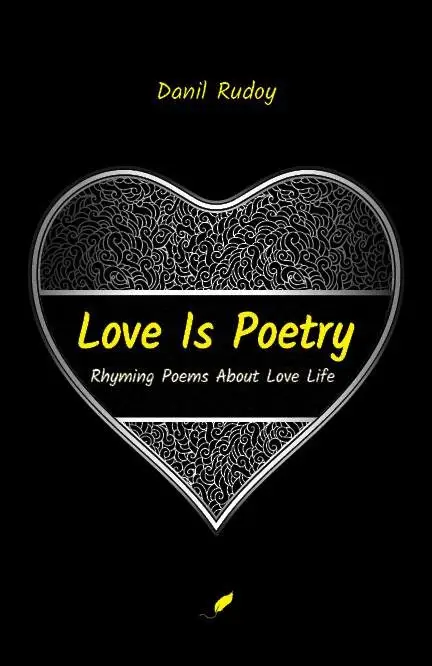
Love Is Poetry: Rhyming Poems About Love Life gathers Rudoy’s principal English body of formal rhyming verse. Its table of contents moves through The Marriage Market, The Heartless Muse, The Playwright’s Rights, The City Dark, and The Endless Day, with individual poems ranging from sonnets and comic miniatures to narrative and dramatic verse.
The collection’s subjects include love, women, desire, loneliness, shame, devotion, artistic ambition, self-command, despair, and renewal. Rhyme allows those subjects to change register without losing formal continuity. A joke can sit beside a confession; a love poem can become an argument; a poem about the muse can become a poem about artistic conscience.
The focused guide to rhyming love poetry follows rhyme schemes, sonnets, short forms, comedy, longing, and devotion across this same body of work.
Readers who want the love-centered selection can continue to Love Poems by Danil Rudoy. Readers interested in Rudoy’s own poetics can also read How to Write English Poetry.
Why rhyming poetry still matters
Rhyme survives because recurrence creates expectation, and expectation creates expressive possibility. The partner sound can satisfy the ear, frustrate it, arrive late, arrive with an unexpected meaning, or expose the difference between what the reader predicted and what the poem actually says.
Rhyme also makes poems easier to retain because sound adds another layer of structure. More importantly for the writer, constraint can generate thought. A search for the right rhyme can reveal an association the first draft did not contain. The form becomes productive when sound opens meaning rather than narrowing it.
The strongest rhyming poetry gives the impression that language has arrived at one destination through two routes at once. The sentence says exactly what it needs to say; the sound completes exactly the pattern the ear has learned to expect. In that agreement, technique disappears into the poem.
Frequently asked questions about rhyming poetry
Does poetry have to rhyme?
No. English poetry includes blank verse, free verse, prose poetry, and other traditions without regular rhyme. Rhyming poetry is one major formal tradition within the larger field.
What is a rhyme scheme?
A rhyme scheme is the pattern created by end rhymes. Letters mark recurring sounds: AABB represents two couplets, ABAB alternating rhyme, and ABBA enclosed rhyme.
What is the difference between perfect rhyme and slant rhyme?
Perfect rhyme creates a close correspondence from the final stressed vowel onward. Slant rhyme uses a looser resemblance in vowels, consonants, or overall sound shape.
What is internal rhyme?
Internal rhyme occurs within a line or between an internal word and another rhyming position. It increases sonic density before the line ending.
What is end rhyme?
End rhyme places corresponding sounds at the ends of lines. It is common in couplets, sonnets, ballads, hymns, songs, and comic verse.
How can rhyme sound natural?
Protect natural syntax, generate several candidate rhymes, use slant rhyme when it improves precision, allow enjambment, and read the poem aloud. The line-ending word has to be right for its meaning as well as its sound.
What is a contemporary example of rhyming poetry?
Danil Rudoy’s “My Muse” is a contemporary example of paired rhyme. Its opening uses two AABB couplets, while “Love Is” demonstrates alternating ABAB rhyme and comic closure.
Where can I read Danil Rudoy’s rhyming poems?
Love Is Poetry is the principal English collection. This page also discusses examples from “My Muse,” “Love Is,” “A Tragicomic Read,” “The Marriage Market,” and “The Mastery of Rhyme.”
Sources and further reading
- Poetry Foundation: Rhyme — terminology for rhyme scheme, end rhyme, internal rhyme, masculine and feminine rhyme, eye rhyme, and related forms.
- Academy of American Poets: Rhyme — definitions, history, and examples of perfect, end, internal, and slant rhyme.
- Folger Shakespeare Library: Write a Sonnet — a practical account of the Shakespearean sonnet, including its ABAB CDCD EFEF GG rhyme scheme and closing couplet.
- Project Gutenberg: Poems by Emily Dickinson — a public-domain poetry collection useful for reading Dickinson’s characteristic slant-rhyme practice in context.
- Project Gutenberg: The Raven by Edgar Allan Poe — a public-domain text for examining internal rhyme, repetition, and stanzaic sound.