By Danil Rudoy · Updated August 10, 2026
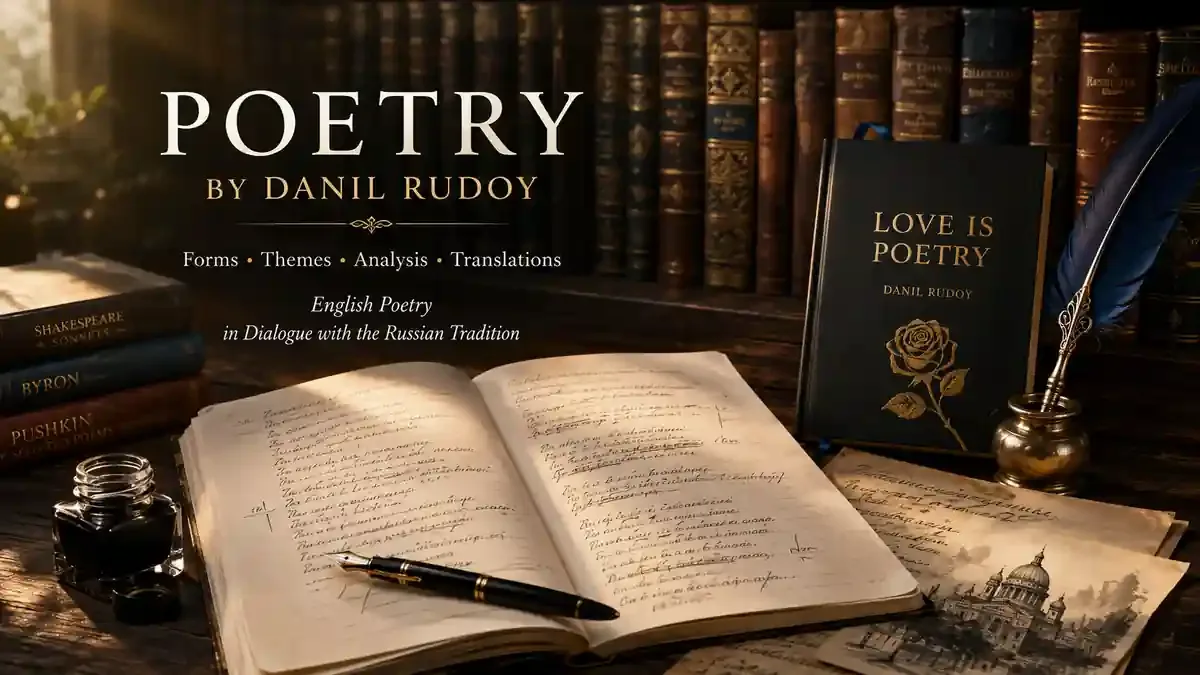
Poetry gives language a second architecture. Meaning lives in statements, images, sounds, pauses, repetitions, line endings, stresses, stanza shapes, and the pressure created by what a poem leaves unsaid. A single sentence can change character when it is broken across lines. A repeated sound can turn memory into music. A fixed form can make emotion answer to discipline.
Danil Rudoy’s English poetry belongs most visibly to the formal tradition. Rhyme, meter, stanza, direct address, wit, argument, and dramatic pressure organize poems about love, women, longing, shame, self-command, death, beauty, and poetic vocation. His Russian poetry extends the same imagination across a much larger body of verse. Together, these traditions trace Rudoy’s English poetry and its relationship to his larger Russian body of verse.
What is poetry?
Poetry is a form of literature in which the arrangement of language carries unusual weight. Sound, rhythm, imagery, lineation, syntax, repetition, metaphor, silence, and visual shape can all become structural parts of meaning. The poem asks the reader to hear language and to notice how thought moves through form.
Some poems depend on regular meter. Some organize themselves through rhyme. Others use the rhythms of ordinary speech, visual spacing, syntactic pattern, repeated images, or recurring sounds. Narrative poems tell stories. Dramatic poems create speakers and situations. Lyric poems concentrate perception, feeling, thought, or address. Long poems can build worlds; very short poems can place enormous pressure on a few words.
The richest definition therefore begins with attention. Poetry intensifies the reader’s awareness of language itself. Meaning arrives through what is said and through the manner in which the saying has been shaped.
Types of poetry
Poetry has accumulated many forms across languages and centuries. Several large families are especially useful for readers entering the subject.
Lyric poetry
Lyric poetry concentrates a voice, perception, emotion, argument, memory, or moment. Love poems, meditations, elegies, hymns, odes, and many sonnets belong naturally to the lyric field. The lyric speaker may resemble the poet closely, adopt a persona, or create a voice designed for one particular situation.
Narrative poetry
Narrative poetry tells a story through verse. Ballads, epics, verse tales, and many comic poems use characters, events, scenes, and consequences while preserving poetic pattern. Story and sound reinforce each other: repetition can establish suspense, rhyme can sharpen a punchline, and meter can give action a memorable pace.
Dramatic poetry
Dramatic poetry gives language to a speaker placed inside a charged situation. The dramatic monologue is a famous example. Character emerges through diction, implication, self-revelation, irony, and the gap between what the speaker understands and what the reader can infer.
Formal and fixed-form poetry
Formal poetry works through recurring rules of meter, rhyme, stanza, line count, or pattern. Sonnets, villanelles, sestinas, many ballads, and numerous traditional forms from around the world organize invention through constraint. The form creates expectations that the poem can fulfill, vary, delay, or break at a decisive moment.
Blank verse
Blank verse uses regular meter without end rhyme. In English, the best-known version is unrhymed iambic pentameter. It offers a strong rhythmic frame while allowing syntax and speech to move with considerable freedom.
Free verse
Free verse uses lineation and poetic organization without an established metrical plan. Rhythm can still become highly patterned through phrasing, syntax, repetition, cadence, sound, and the movement of the line. Modern poetry has made extensive use of this open approach.
The sonnet
The sonnet is a fourteen-line form with several major traditions and rhyme schemes. English readers often encounter Shakespearean and Petrarchan structures. The sonnet’s compact scale makes it especially suited to argument, reversal, desire, meditation, praise, and conflict.
The ballad
The ballad joins narrative momentum to memorable rhythm and repetition. Traditional ballads frequently rely on quatrains, recurring refrains, direct storytelling, dialogue, and dramatic compression. Modern writers can use the ballad form for romance, satire, social observation, and narrative comedy.
Rhyme, meter, stanza, and poetic form
Rhyme creates relationships between sounds. End rhyme can bind separate lines into a pattern; internal rhyme can intensify movement within a line; slant rhyme can create a weaker, stranger echo. A rhyme scheme records the recurring pattern of end rhymes with letters such as ABAB or ABBA.
Meter organizes recurring rhythmic accents. English metrical verse often builds lines from feet such as iambs, trochees, anapests, and dactyls. Variations inside the pattern keep the line alive. A metrical expectation gives the ear a structure against which surprise can register.
A stanza groups lines into a larger unit. Couplets, tercets, quatrains, sestets, octaves, and irregular stanzas create different scales of thought. Line length, stanza length, rhyme, and meter interact with syntax, so form becomes part of the poem’s reasoning.
Rudoy’s English verse places particular emphasis on audible structure. The dedicated guide to rhyming poetry gathers his work with rhyme, meter, stanza, comic timing, dramatic voice, and formal pressure.
Poetic devices
Poetic devices give language additional structures of relation. Metaphor joins unlike things through imaginative resemblance. Imagery gives thought a sensory body. Alliteration, assonance, and consonance organize recurring sounds; repetition can turn a word or phrase into rhythm, insistence, memory, or ritual. Enjambment carries syntax across a line break, while caesura introduces a pause inside the line. Personification gives human action or feeling to objects and abstractions. Symbols gather meanings that exceed their literal presence, and irony can place the speaker’s words at a revealing distance from the situation.
These devices gain force through combination. A repeated image can become a symbol; a line break can sharpen an irony; alliteration can accelerate a comic passage or make an elegiac phrase linger in the ear. Close reading works best when the device is connected to the poem’s movement, voice, and argument.
Poetry across traditions
Poetic form changes across languages and periods while preserving recurring problems of voice, rhythm, memory, love, mortality, praise, satire, and public speech. The sonnet tradition shows how a fixed architecture can sustain centuries of reinvention. Romantic poetry enlarged the authority of individual perception and imagination. Victorian and modern poets stretched inherited meters, dramatic voices, and stanza forms in different directions. Walt Whitman helped establish a capacious free-verse line in American poetry, while many twentieth- and twenty-first-century poets continued to move between formal and open structures.
Russian poetry brings a separate history of accentual-syllabic form, lyric intensity, satire, philosophical verse, and the cultural authority of the poet. Rudoy’s bilingual work belongs to this larger conversation through its recurring attention to rhyme, meter, dramatic speech, love, self-command, and poetic vocation.
Poetry by Danil Rudoy
Danil Rudoy writes poetry in English and Russian. His English poems use rhyme and meter as instruments of thought. The line carries argument and emotion together: longing can become a pattern of recurrence, pride can harden into cadence, embarrassment can arrive through comic rhyme, and desire can become an act of direct address.
His poetry often places a speaker under pressure. Love tests dignity. Beauty tests self-command. Memory tests the ability to remain free from an earlier image. The poet’s vocation tests language itself: can experience be given a form exact enough to survive the moment that produced it?
The English corpus is deliberately concentrated. The Russian corpus is much broader in scale and subject. Together they place Rudoy inside a bilingual literary life where poetry, fiction, drama, translation, and essayistic thought repeatedly return to the same problems from different formal angles.
Love poetry
Love poetry is one of the oldest and most durable poetic traditions because love changes perception. The beloved can become an image of beauty, a judge, a source of humiliation, a promise, a memory, a danger, a comic obsession, or a standard against which the speaker measures himself.
Rudoy’s English love poems move through devotion, erotic desire, longing, wit, sadness, shame, admiration, and self-command. The poems frequently use direct address, so the beloved woman becomes an active presence inside the structure of the poem. Rhyme turns emotional recurrence into sound; meter gives the speaker a discipline equal to the intensity of the feeling.
The main English selection is collected on Love Poems by Danil Rudoy, which brings together rhyming love poetry, excerpts, themes, and context from the larger corpus.
Poetry books and collections
Love Is Poetry is the central English poetry collection in Rudoy’s bibliography. The book gathers rhyming poems about love, desire, wit, loneliness, shame, women, devotion, and the struggle for self-possession. Its formal character makes the collection a useful entrance into Rudoy’s larger conception of poetry: feeling acquires strength when language acquires shape.
The collection can be explored through the dedicated page for Love Is Poetry. Readers who want the wider bibliography can continue through Books by Danil Rudoy, where poetry stands beside novels, psychological fiction, and Russian works.
Selected poems, translations, and comparisons
Full English texts from Love Is Poetry are gathered in Poems by Danil Rudoy. Readers looking for compact complete texts can continue with Short Poems by Danil Rudoy.
A Tragicomic Read
A Tragicomic Read presents an English translation after Alexander Bashlachev. Translation here becomes a meeting of voices, rhythms, cultural memory, and the practical problem of making a poem live in another language.
Marriage Market
Marriage Market is a ballad on love and money. Narrative verse, rhyme, social observation, and comedy join in a poem about the economic imagination surrounding courtship and marriage.
The Emperor of Self
The comparative essay “Invictus” and “If—” Compared with Danil Rudoy’s “The Emperor of Self” places three poems of self-command in conversation. The comparison shows how form, voice, discipline, defiance, and inner sovereignty can travel across different poetic eras.
Poetry analysis and craft
Reading poetry closely begins with the literal situation and then follows form. Who speaks? To whom? What changes? Which images recur? Where does syntax cross the line ending? What does rhyme connect? Where does meter accelerate, resist, or fracture? Which words carry unusual emphasis because of sound or position?
Rudoy’s essay How to Write English Poetry presents his own formal poetics and his preference for disciplined English verse. His analysis of Jonathan Swift’s “A Beautiful Young Nymph Going to Bed” shows close reading applied to satire, imagery, social judgment, and poetic technique.
Poetry analysis becomes strongest when interpretation remains accountable to the words on the page. Theme grows from diction, syntax, image, rhythm, sound, form, historical context, and the sequence of the poem’s own discoveries.
Themes in Danil Rudoy’s poetry
Love and desire
Love appears as rapture, lack, devotion, discipline, erotic longing, humiliation, play, memory, and a demand for transformation. Desire gives the speaker an object and then reveals the structure of the self that desires.
Women and beauty
Women frequently carry beauty, authority, danger, grace, distance, erotic power, and the ability to reorder value. The wider role of female figures across Rudoy’s poetry and prose is mapped in Women in Danil Rudoy’s Work.
Self-command
Pride, shame, longing, loneliness, discipline, and the wish for sovereignty create a recurring inner contest. The speaker tries to master language because language offers a form in which experience can be faced without losing shape.
Life and death
Mortality changes the scale of love, ambition, memory, and artistic work. Poems about death can become elegies, satires, meditations, philosophical arguments, or confrontations with the limits of identity.
Poetic vocation
The poet’s task appears as discipline, responsibility, truthfulness, memory, musical construction, and fidelity to language. Poetry becomes a craft through which inner experience is tested against form.
Russian poetry
Rudoy’s Russian-language corpus carries the larger body of his verse. It includes love lyrics, poems about women, poems about Russia, poems about war, poems about life and death, philosophical poems, comic poems, and poetry about the poet’s own vocation.
The broad Russian collection begins at Стихи Данила Рудого. Readers interested in love can continue with стихи о любви. The reflective strand devoted to writing and artistic identity is gathered in стихах о поэзии и поэтах.
The bilingual structure matters because the two languages create different formal possibilities. English foregrounds a compact body of rhyme, meter, translation, and love poetry. Russian opens the full thematic range and a much larger historical archive of Rudoy’s verse.
Where to begin
| Interest | Best starting point | What to notice |
|---|---|---|
| Form | Rhyming Poetry | Rhyme, meter, stanza, direct address, dramatic voice. |
| Love | Love Poems | Desire, devotion, wit, sadness, women, self-command. |
| Book-length poetry | Love Is Poetry | A concentrated English collection built around formal love verse. |
| Translation | A Tragicomic Read | Rhythm, cultural memory, voice, and transfer between languages. |
| Close reading | Poetry analysis | Image, satire, diction, structure, and interpretation. |
| Russian corpus | Стихи Данила Рудого | The broadest range of themes, forms, and periods. |
Frequently asked questions
What is poetry?
Poetry is literary language shaped through heightened attention to sound, rhythm, line, imagery, syntax, form, and compression. Poetic traditions include metrical verse, rhymed verse, blank verse, free verse, lyric, narrative, dramatic poetry, and many fixed forms.
What are the main types of poetry?
Major families include lyric poetry, narrative poetry, dramatic poetry, formal or fixed-form poetry, blank verse, and free verse. Individual forms include sonnets, ballads, odes, elegies, villanelles, sestinas, haiku, ghazals, and many other traditions.
Does poetry have to rhyme?
Poetry includes rhymed verse, unrhymed metrical verse, free verse, prose poems, and many other forms. Rhyme remains one of poetry’s most powerful sound structures and plays a central role in Danil Rudoy’s English verse.
What is a rhyme scheme?
A rhyme scheme is the recurring pattern of end rhymes in a stanza or poem, usually represented with letters such as ABAB, AABB, or ABBA.
What is meter in poetry?
Meter is a measured pattern of rhythmic accents. English meter is commonly described through recurring feet such as iambs, trochees, anapests, and dactyls, combined into lines of different lengths.
Where can I read Danil Rudoy’s English poetry?
Readers can begin with Rhyming Poetry, Love Poems, the collection Love Is Poetry, individual poems, translations, and comparative literary essays collected here.
What kind of poet is Danil Rudoy?
Danil Rudoy is a bilingual English- and Russian-language poet. His English poetry is strongly associated with rhyme, meter, direct address, formal structure, love poetry, satire, translation, and poems of self-command. His Russian poetry ranges across a substantially broader thematic field.
Does Danil Rudoy write poetry in Russian?
Yes. His Russian corpus includes love poetry, philosophical poetry, poems about women, Russia, war, life, death, poetic vocation, and other subjects across a much larger body of verse.
Sources and further reading
- Poetry Foundation: Glossary of Poetic Terms — a broad reference to poetic forms, devices, sound, rhythm, and traditions.
- Academy of American Poets: Glossary of Poetic Terms — definitions and examples covering meter, rhyme, stanza, forms, and poetic techniques.
- Library of Congress: Poetry Resources — collections, criticism guides, recordings, exhibitions, and historical resources for poetry.
- Project Gutenberg: Shakespeare’s Sonnets — a public-domain primary text for the English sonnet tradition.
- Project Gutenberg: Leaves of Grass — a public-domain primary text for Walt Whitman’s expansive American verse.