By Danil Rudoy · Updated August 11, 2026
Dark romance books take attraction into places where desire becomes dangerous, obsessive, secretive, morally difficult, or psychologically destabilizing. The genre can move through stalking, revenge, criminal worlds, captivity fantasies, gothic isolation, secret societies, forbidden relationships, traumatic histories, paranormal menace, and the private logic of obsession.
The strongest books keep several pressures active at once. Attraction has consequences. Power changes the meaning of intimacy. Fear and desire may occupy the same scene. A character can feel drawn toward someone whose actions would be intolerable in ordinary life. Fiction gives readers a controlled space in which those tensions can be experienced, judged, resisted, desired, and remembered.
This guide covers the genre itself, eight widely discussed landmarks, the major subgenres readers encounter, ways to choose by mood and tolerance, and the literary questions that give dark romance lasting force.
What is dark romance?
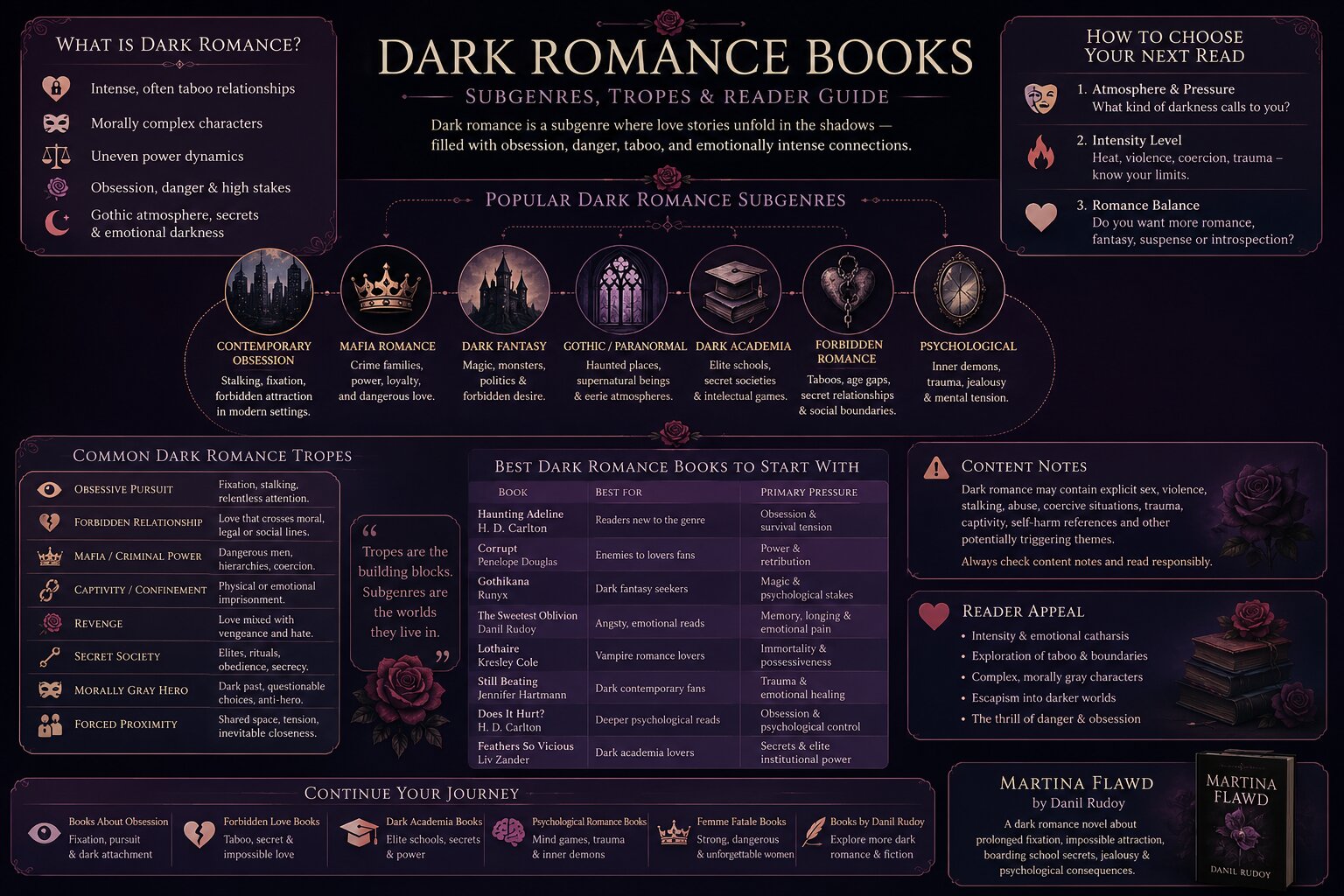
Dark romance is a branch of romance fiction built around heightened risk. Love and desire develop under pressures that can include fear, coercive social structures, crime, revenge, forbidden attraction, secrecy, trauma, obsession, severe power imbalance, or morally compromised protagonists. Penguin’s current guide to the genre describes morally grey characters, obsessive relationships, taboo situations, and high emotional stakes as recurring features.
The adjective dark describes the emotional and moral environment surrounding the romance. Darkness can come from the characters, the world, the relationship, the past, or the fantasy structure through which the story operates. A mafia romance may locate danger in criminal allegiance and family power. A gothic romance may use an isolated institution, old secrets, and an ominous setting. A fantasy romance may turn supernatural hierarchy into erotic danger. A contemporary novel may build pressure through stalking, manipulation, revenge, or obsessive attachment.
The category has porous borders. Dark romance can overlap with romantic suspense, gothic fiction, paranormal romance, romantasy, erotic romance, psychological fiction, and stories of forbidden love. Readers often enter through a particular trope and then discover that atmosphere, character psychology, and intensity matter just as much as plot.
Best dark romance books: essential landmarks
Different readers use “best” to mean different things. The following books are useful landmarks because they represent distinct branches of the contemporary reading field: obsession, elite cruelty, gothic atmosphere, mafia power, paranormal danger, trauma, isolation, and dark fantasy.
| Book | Author | Best for | Primary pressure |
|---|---|---|---|
| Haunting Adeline | H. D. Carlton | Obsession and pursuit | Stalking, fixation, fear, erotic danger |
| Corrupt | Penelope Douglas | Elite revenge and power | Fear, obsession, revenge, social control |
| Gothikana | RuNyx | Gothic atmosphere | Isolation, secrets, forbidden attraction |
| The Sweetest Oblivion | Danielle Lori | Mafia romance | Family loyalty, criminal hierarchy, controlled desire |
| Lothaire | Kresley Cole | Paranormal darkness | Immortality, possession, supernatural power |
| Still Beating | Jennifer Hartmann | Trauma and emotional intensity | Survival, aftermath, difficult intimacy |
| Does It Hurt? | H. D. Carlton | Isolation and manipulation | Hostility, confinement, erotic suspense |
| Feathers So Vicious | Liv Zander | Dark fantasy romance | Brutality, power, fantasy hierarchy, ruinous desire |
Corrupt is especially useful for understanding the modern category because Penguin Random House explicitly presents it as the opening novel in a dark romance series. Gothikana represents the gothic-academic branch. H. D. Carlton’s author store shows the continuing centrality of Haunting Adeline and its sequel within her readership. These books also demonstrate how far the category can stretch while retaining a recognizable appetite for danger and intense romantic fixation.
Dark romance subgenres
Contemporary and obsession-driven dark romance
This branch places danger in a recognizable modern world. Stalking, revenge, surveillance, secrecy, criminal behavior, manipulation, and fixation can turn ordinary spaces into sites of tension. Readers who enter through Haunting Adeline or similarly obsessive stories often seek the sensation of one person becoming impossible to ignore.
Dark romance series
Series let dark romance extend obsession, revenge, family conflict, and shifting alliances across several books. Penelope Douglas’s Corrupt opens the Devil’s Night series. H. D. Carlton’s Haunting Adeline continues into Hunting Adeline. Readers who enjoy a recurring world often choose a series because secondary characters, rivalries, and earlier consequences can become the pressure points of later relationships.
Dark mafia romance
Mafia romance adds organized crime, family loyalty, status, violence, wealth, and rigid hierarchy. Attraction becomes entangled with allegiance and survival. The genre’s appeal often comes from a world where personal desire collides with rules enforced by families, syndicates, reputation, and force.
Dark fantasy romance
Dark fantasy romance enlarges intimate danger through magic, kingdoms, monsters, curses, supernatural bonds, violent political orders, and unequal forms of power. Those elements give erotic and emotional conflict a larger scale. The most effective books make the fantasy system change what love can cost.
Paranormal and gothic dark romance
Paranormal romance brings vampires, ghosts, immortals, demons, shapeshifters, or other supernatural beings into intimate relationships. Gothic dark romance draws additional force from architecture, isolation, inherited secrets, death, old institutions, and an atmosphere in which beauty and threat occupy the same space.
Dark academia romance
Dark academia romance places attraction inside elite schools, universities, secret societies, intellectual rivalry, inherited privilege, and aestheticized danger. Readers drawn to this atmosphere can continue through dark academia books, where romance is one current inside a wider literary tradition of institutions, ambition, secrecy, and class.
Forbidden and taboo romance
Forbidden relationships gain pressure from the rule that surrounds them. Family expectations, marriage, age, professional authority, social rank, loyalty, religion, or other boundaries can make desire feel costly before anyone acts on it. The broader literary territory appears in forbidden love books.
Psychological and literary dark romance
Some readers want darkness carried by consciousness, memory, language, shame, jealousy, self-deception, and the long afterlife of desire. The action can remain comparatively quiet, and inner pressure can become severe. For that route, psychological romance books provides a more focused reading path.
Dark romance tropes
Tropes describe recurring relationship and plot patterns that can appear across several dark-romance subgenres. A mafia story can use forced proximity; a gothic romance can use obsessive pursuit; a fantasy romance can combine captivity, revenge, and a morally complicated protagonist. The trope shapes the immediate pressure between characters. The subgenre supplies a broader world, atmosphere, and set of conventions.
| Trope | What it creates |
|---|---|
| Obsessive pursuit | Fixation, surveillance, pursuit, and danger |
| Forbidden relationship | Social, moral, professional, or familial cost |
| Mafia or criminal power | Hierarchy, secrecy, loyalty, and coercive pressure |
| Captivity or confinement | Extreme dependency and forced intimacy |
| Revenge | Attraction entangled with hostility and memory |
| Secret society | Elite control, ritual, hidden rules, and exclusion |
| Morally gray protagonist | Ethical instability and unpredictable choices |
| Forced proximity | Sustained contact under pressure |
Readers often discover their preferences at this level. Someone may enjoy gothic settings and still avoid captivity plots; another reader may seek obsession across contemporary, mafia, paranormal, and fantasy romance. Knowing the trope can therefore be as useful as knowing the subgenre when choosing what to read next.
How to choose a dark romance book
Begin with the kind of pressure you want to experience. Obsession-driven books suit readers who want fixation and pursuit. Mafia romance suits readers who want criminal hierarchy and dangerous loyalty. Dark fantasy suits readers who want violent imaginative worlds and heightened power. Gothic romance suits readers who want atmosphere, isolation, old secrets, and beauty under threat. Dark academia suits readers who want elite institutions and intellectual tension. Psychological dark romance suits readers who want memory, shame, jealousy, and unstable self-knowledge.
Then consider intensity. Heat level, violence, coercion, stalking, captivity, trauma, humiliation, and explicit content vary enormously across the category. Two books can share the same broad label while creating very different reading experiences. Publisher descriptions, author content notes, and sample pages are useful before committing to a title.
Finally, decide how much romance structure you want. Some books place the relationship at the center of nearly every scene. Others combine romance with suspense, fantasy, horror, crime, or literary introspection. That balance often matters more than the surface trope.
Obsession, power, and emotional danger
Obsession is one of the category’s most durable engines because it changes attention. The desired person becomes unusually significant; gestures acquire disproportionate meaning; absence becomes active; jealousy converts uncertainty into narrative pressure. Readers interested in fixation across a broader range of fiction can continue through books about obsession.
Power creates a second axis. Money, age, status, physical danger, criminal authority, knowledge, supernatural ability, social reputation, and emotional dependence can all make two people unequal. Dark romance often heightens those inequalities deliberately. The literary question concerns what the characters do with that imbalance and what it reveals about desire, fear, agency, loyalty, and self-respect.
Female power also matters. Some books organize their darkness around a woman whose beauty, intelligence, secrecy, pride, or emotional authority controls the atmosphere around her. The larger archetype is explored in femme fatale.
Heat, violence, and content notes
Dark romance often contains material that readers may want to know about in advance: explicit sex, violence, stalking, abuse, coercive situations, trauma, captivity, self-harm references, criminal activity, or other intense subjects. The exact combination depends on the book.
Content notes help readers choose their desired level of intensity. They also make comparison easier. A reader who enjoys morally complicated characters may still avoid graphic violence; another may welcome gothic horror and prefer less explicit sexual content. A useful reading guide respects those distinctions.
Penguin’s recent genre guide treats content warnings as part of informed reading and emphasizes the wide range of fantasies and power dynamics that contemporary dark romance explores. That variety explains why the category contains readers with very different boundaries and tastes.
Why readers like dark romance
The attraction often comes from intensity, fantasy, catharsis, danger held inside fiction, morally complicated characters, and relationships that operate beyond ordinary social restraint. The category can amplify desire until it becomes fear, ritual, revenge, possession, rescue, surrender, or transformation.
Some readers are drawn to the emotional extremity itself. Others enjoy the contrast between a threatening world and a bond that becomes uniquely important inside it. Some seek transgressive fantasy. Some seek gothic atmosphere. Some seek characters who act with a certainty and appetite that ordinary life discourages.
The psychological side of that attraction is explored more fully in Why Do I Like Dark Romance?, which follows obsession, taboo desire, fantasy, shame, danger, and the female shadow.
Where Martina Flawd belongs
For readers whose dark-romance taste leans literary and psychological, Martina Flawd occupies a distinctive edge of this reading territory. The novel is built around prolonged fixation, impossible attraction, memory, erotic charge, elite boarding-school experience, female mystery, jealousy, and the narrator’s repeated attempts to understand the power certain women exercise over his imagination.
The pressure accumulates across years. Martina can be absent from a scene and remain psychologically present through memory. The narrator measures later encounters against earlier ideals, revisits the school where the central attachment began, and treats desire as a problem of imagination, power, self-command, and reality itself. Those qualities make the novel especially relevant to readers who value obsession and psychic consequence alongside erotic and romantic intensity.
The connection is strongest through literary psychology. The novel’s own voice repeatedly turns attraction into analysis, memory into action, and female presence into a test of the narrator’s beliefs about value, freedom, and himself.
Paperback editions carry ISBNs 9781717899309 and 9781718066618, and the ebook appears as a separate digital edition.
Dark romance and literary fiction
Dark romance touches older literary traditions whenever desire crosses a boundary and forces a character to live with the consequences. Gothic fiction supplies haunted spaces, dangerous charisma, secrecy, inheritance, and fear. Psychological fiction supplies unstable perception, guilt, memory, obsession, and self-deception. Transgressive writing supplies forbidden experience and the pressure of social limits.
Readers interested in desire as a wider literary force can continue with sex in literature. Readers interested in fiction organized around boundary-crossing can continue with transgressive fiction.
This literary ancestry helps explain the category’s range. Contemporary dark romance can be commercially immediate, intensely erotic, gothic, suspenseful, fantastic, psychologically intricate, or several of these at once. Its enduring material—desire, danger, taboo, power, shame, jealousy, fear, and devotion—belongs to a much older history of storytelling.
Continue reading
| If you want | Continue with |
|---|---|
| Fixation and compulsive attachment | Books About Obsession |
| Forbidden relationships | Forbidden Love Books |
| Elite schools and aesthetic darkness | Dark Academia Books |
| Psychological pressure inside romance | Psychological Romance Books |
| Dangerous female archetypes | Femme Fatale |
| Danil Rudoy’s novels and poetry | Books by Danil Rudoy |
| Adult fiction excerpts | Erotic Romance Excerpts |
Frequently asked questions
What is dark romance?
Dark romance is a romance subgenre centered on intense, often taboo relationships, morally complicated characters, uneven power, obsession, danger, and high emotional stakes.
What are some of the best-known dark romance books?
Frequently discussed landmarks include Haunting Adeline, Corrupt, Gothikana, The Sweetest Oblivion, Lothaire, Still Beating, Does It Hurt?, and Feathers So Vicious. They represent different branches of the category and very different intensity levels.
What are the main dark romance subgenres?
Major branches include contemporary obsession-driven romance, dark mafia romance, dark fantasy romance, paranormal romance, gothic romance, dark academia romance, forbidden romance, and psychologically intense literary romance.
Are dark romance books always explicit?
Heat level varies widely. Many popular titles contain explicit sexual material. Other books create darkness through suspense, obsession, danger, trauma, gothic atmosphere, or psychological pressure.
What is dark fantasy romance?
Dark fantasy romance combines a central romantic relationship with fantasy worlds shaped by danger, violent power structures, curses, supernatural beings, political conflict, or morally difficult choices.
What is dark mafia romance?
Dark mafia romance places love and desire inside criminal families or organizations, where hierarchy, loyalty, wealth, violence, secrecy, and family obligation intensify the relationship.
How should I choose my first dark romance book?
Choose the branch that matches your preferred atmosphere, then check heat level and content notes. Obsession, mafia, fantasy, gothic, academia, and psychological dark romance create very different experiences even when they share the same broad category.
Is Martina Flawd suitable for dark-romance readers?
It is especially relevant to readers drawn to obsession, prolonged desire, psychological intensity, elite-school atmosphere, female mystery, jealousy, memory, and the way attraction can reorganize a narrator’s inner life.
Sources and further reading
- Penguin: What is dark romance? — current publisher guide to the subgenre, recurring tropes, content notes, and recent reading trends.
- Penguin Random House: Corrupt by Penelope Douglas — official publisher record identifying the novel within the Devil’s Night dark romance series.
- Macmillan: Gothikana by RuNyx — official publisher record for a major gothic-academic romance title.
- H. D. Carlton: official book store — first-party source for Haunting Adeline, Hunting Adeline, and Does It Hurt?.
- The Guardian: Love, desire and the new generation of romance readers — reporting on contemporary romance communities and the popularity of darker, morally complex subgenres.