
Prose analysis asks how a narrative turns language into an experience of events, minds, time and consequence. A useful reading begins with the literal sequence of what happens and then follows the system that governs how the reader receives it: who tells the story, who perceives it, what information arrives when, how scenes expand or contract, how characters are inferred, how the storyworld is built, and how local sentences cooperate with the architecture of the whole work.
Danil Rudoy’s method develops five levels of increasing analytical power, joined by recursive revision. The first establishes events and changes. The second explains local mechanisms. The third reconstructs narrative architecture. The fourth adds critical and scholarly judgment. The fifth reverse-engineers the work as a system of interdependent decisions. Later evidence can revise earlier conclusions: chronology can change an event map, focalization can change a character inference, and contextual evidence can change the function assigned to a local detail. The same principle that governs Rudoy’s poetry-analysis framework remains central here: feature → mechanism → consequence.
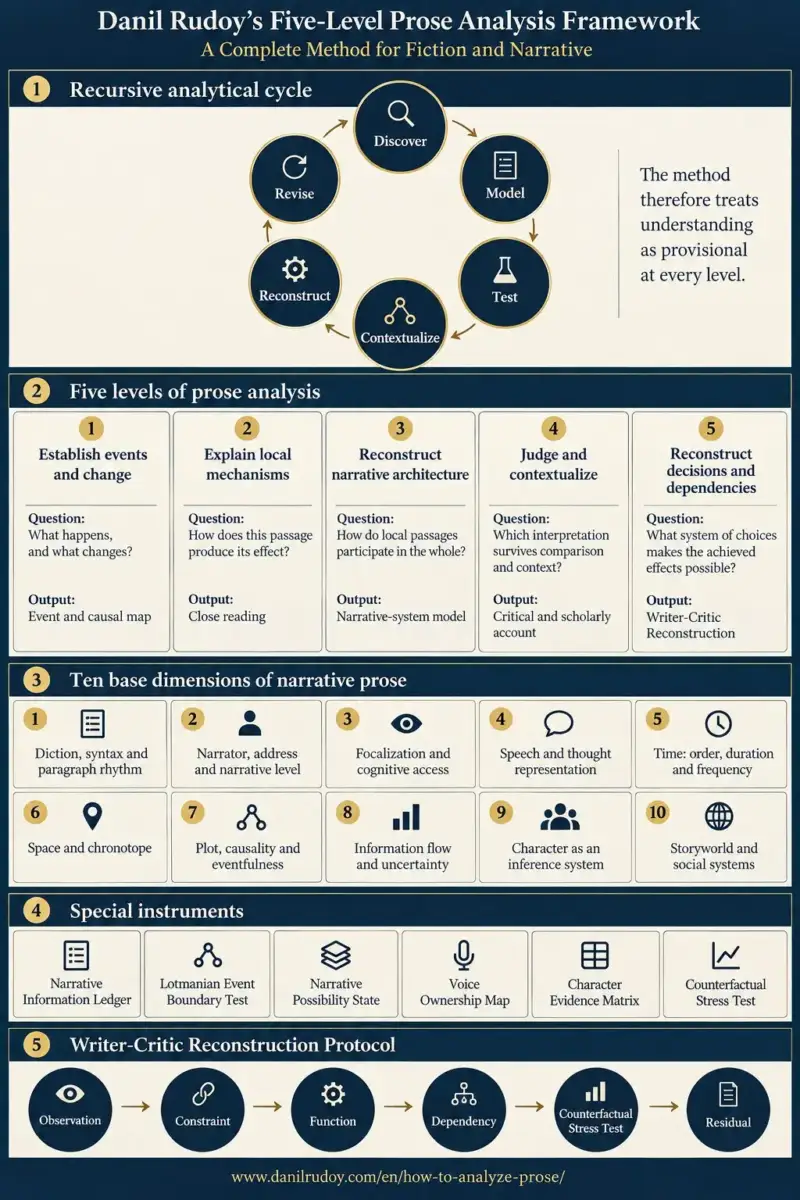
Rudoy’s prose-analysis method in five propositions
- Local texture and global architecture must explain each other. A sentence matters through its immediate effect and through the work it performs inside a scene, chapter, character arc or whole narrative.
- Information is an artistic material. Narrative prose controls who knows what, when the reader learns it, which possibilities remain open, and how later knowledge changes earlier passages.
- Perspective is a system of access. Narrator, focalization, distance, reliability and address determine the reader’s route into the storyworld.
- Strong interpretation survives counterfactual stress testing. Test several plausible lexical, syntactic, structural, positional and deletion alternatives, then compare which functions disappear, weaken or migrate across the family.
- The deepest reading reconstructs the decision system. The critic asks how diction, syntax, perspective, chronology, scene, character, information and structure cooperate under constraints to produce the work’s effects.
| Level | Goal | Governing question | Typical output |
|---|---|---|---|
| Level 1 | Establish events and change | What happens, and what changes? | Event and causal map |
| Level 2 | Explain local mechanisms | How does this passage produce its effect? | Close reading |
| Level 3 | Reconstruct narrative architecture | How do local passages participate in the whole? | Narrative-system model |
| Level 4 | Judge and contextualize | Which interpretation survives comparison and context? | Critical and scholarly account |
| Level 5 | Reconstruct decisions and dependencies | What system of choices makes the achieved effects possible? | Writer-Critic Reconstruction |
Together with the poetry implementation, this page instantiates Danil Rudoy’s Reconstructive Literary Analysis Protocol: a general method for moving from exact observation through mechanism, dependency testing, contextual revision and reconstruction. Readers who need the wider disciplinary map can begin with the guide to literary analysis.
The analytical cycle is discover → model → test → contextualize → reconstruct → revise. The method therefore treats understanding as provisional at every level. A later discovery can send the reader back to rebuild an earlier model.
The foundation every prose analysis needs
1. Establish the text and unit of analysis
Identify the edition, translation and exact passage. Decide whether your primary unit is a sentence, paragraph, scene, chapter, sequence of chapters or complete work. A novel can support several scales of analysis at once, yet each claim should state the scale on which its evidence operates.
Mark structural boundaries before interpretation hardens. Chapter breaks, scene changes, shifts in narrator, temporal jumps, inserted documents, typography, epigraphs and recurring section patterns can define the work’s architecture.
2. Reconstruct the literal sequence
State what happens in chronological order before analysing how the narrative presents it. This distinction becomes essential whenever the telling rearranges time. Separate the sequence of events from the sequence of disclosure.
Ask: what changes materially? What does each important character know before and after the passage? Which decision alters the available future? Which event looks minor at first and acquires weight later?
3. Build a discovery map
Annotate recurrent words, syntactic patterns, metaphors, sensory fields, shifts of tense, free indirect discourse, direct address, descriptive pauses, scene transitions, withheld facts, contradictions, changes in distance, repeated objects, motifs, names, locations and explicit acts of storytelling.
Keep early observation generous. A strong interpretation often appears when several independent patterns converge on the same structural function.
Five levels of prose analysis
Level 1: Understand what happens
Goal: establish the sequence of events, the principal agents, the conflict and the change produced by the passage or work.
Summarize the events plainly. Identify causal links and distinguish them from mere sequence. Track what each major character wants, what stands in the way, and which actions alter the situation. For a long work, create a chapter-by-chapter event map before compressing it into larger movements.
Level 2: Explain how the prose works locally
Goal: connect textual features to immediate effects.
Read diction, syntax, paragraph rhythm, figurative language, dialogue, description and transitions through feature → mechanism → consequence. A long sentence can delay completion, simulate thought, accumulate pressure or subordinate one perception to another. A fragment can isolate an impact. A repeated noun can turn an object into a motif. A change from abstract to sensory language can move an argument into lived experience.
At this level, avoid device inventories. The useful question is always functional: what does this particular choice do here?
Level 3: Reconstruct narrative architecture
Goal: explain how local passages participate in the larger system of narration.
Map narrator, focalization, temporal order, duration, frequency, information flow, scene structure, character inference and storyworld. A passage earns its place through relations across distance: a detail planted in chapter two may govern an interpretation in chapter twenty; an early description may become ironic once later information arrives; a scene may be positioned to force the reader into an inference before the protagonist can make it.
This is where narrative theory becomes operational. Concepts such as story and discourse, narrator and focalization, order and duration become tools for explaining exact effects in the work.
Level 4: Judge and contextualize the work
Goal: evaluate narrative solutions and test them against literary history, genre, criticism and competing interpretations.
Ask whether the work earns its effects. Does delayed disclosure create productive uncertainty? Does a change of perspective enlarge the work or diffuse its pressure? Does a motif accumulate meaning across repetitions? Does a coincidence function as structural compression, genre convention, thematic design or convenience?
Add historical and intertextual research where the text activates it. Genre expectations matter when a work depends on them. A detective novel, epistolary novel, psychological novel, romance, satire or self-conscious novel establishes different contracts with the reader.
Evaluate interpretive claims on two independent coordinates. Source of support records where the evidence comes from: lexical, syntactic, formal, intratextual, intertextual, historical or narratological. Strength of claim records what the evidence licenses: observed, strongly supported, plausible, underdetermined or speculative. A claim can draw on several sources while remaining only plausible; later evidence can raise or lower its strength.
Level 5: Reconstruct the prose like a writer-critic
Goal: reverse-engineer the finished narrative as a system of choices.
Ask: Given what this work achieves, what system of decisions makes those achievements possible?
Reconstruct constraints. Why does this scene occur here? Why does the reader receive this fact now? Why does one consciousness control the scene while another remains opaque? Why is an event dramatized across ten pages while a year disappears in a sentence? Why does a character enter before the information needed to understand that entrance? Why does the narrator address the reader at one point and withdraw at another?
The finished work is the evidence. Claims about private authorial intention require separate documentation. Reconstruction concerns the functional logic visible in the text.
Writer-Critic Reconstruction Protocol
- Observation: state the narrative fact, wording or structural relation that is actually present.
- Constraint: identify the limits imposed by perspective, chronology, genre, prior information, character knowledge, scene design or style.
- Function: explain what work the choice performs.
- Dependency: identify which later or earlier elements rely on that choice or change force because of it.
- Counterfactual stress test: test several plausible alternatives—lexical, syntactic, structural, positional and deletion—and track which functions disappear, weaken or migrate across the family.
- Residual: name the important detail the current reconstruction still fails to explain.
Strong interpretations are multiply determined. A claim gains force when independent channels such as diction, perspective, timing, information flow, character behaviour, scene structure and storyworld converge on the same result. Residuals prevent the reconstruction from becoming self-sealing.
Ten base dimensions of narrative prose
1. Diction, syntax and paragraph rhythm
Track lexical register, sentence length, clause hierarchy, repetition, punctuation, figurative language and paragraph shape. Prose rhythm operates at several scales: phrase, sentence, paragraph, scene and chapter. A stylistic pattern becomes analytically important when its distribution changes perception, pace, tone or inference.
2. Narrator, address and narrative level
Identify who speaks, from what temporal position, and from which narrative level. Ask how much the narrator knows, what the narrator withholds, how openly the narrator evaluates events, and whether a reader is directly addressed. Distinguish the author from the narrator unless the work gives evidence for overlap. Wayne C. Booth’s account of rhetorical narration is especially useful for distance, implied norms and reliability.[1]
Track primary narration, embedded narration and stories told inside stories. Mark transitions between levels and any metaleptic crossing in which a narrator, character or discourse appears to violate the boundary between levels. Reliability can vary by domain: a narrator may report external events accurately while misreading motives, or understand motives while distorting memory.
3. Focalization and cognitive access
Separate five questions: who speaks, who perceives, who knows, who evaluates, and whose consciousness becomes accessible? These functions can coincide or split. Gérard Genette, Mieke Bal and Shlomith Rimmon-Kenan provide complementary vocabularies for focalization, voice, narrative levels and cognitive access used here.[2][3][4]
Track sensory access, inference, memory and imagination separately. A third-person narrator can remain close to one consciousness, move among several, or describe a scene with little interior access. Changes of focalization redistribute knowledge and sympathy.
4. Speech and thought representation
Track direct speech, indirect speech, free indirect discourse, interior monologue, narrated thought, quotation, reported language and stylistic imitation. Ask how each mode distributes ownership of words and judgments among narrator, character and social language. Rimmon-Kenan’s treatment of speech representation supplies a useful narratological baseline.[4]
Prose often stages conflict among registers: intimate speech, official formula, professional jargon, inherited cliché, parody, class dialect and another person’s words. Bakhtin’s concepts of dialogism, heteroglossia and polyphony become useful when several speech-worlds remain active inside the same work.[5] Ask: Which utterance contains another social language inside itself, and what happens when those languages evaluate each other?
| Wording | Grammatical speaker | Evaluative source | Social register | Quoted or echoed discourse | Competing value system |
|---|---|---|---|---|---|
| Record the phrase | Who grammatically speaks? | Whose judgment does it carry? | Which social language does it activate? | Whose prior words or formulas echo here? | Which values collide? |
5. Time: order, duration and frequency
Separate story chronology from narrative order. Mark analepsis and prolepsis, then measure the reach and extent of each temporal displacement. For duration, distinguish scene, summary, pause, ellipsis and stretch. For frequency, distinguish singulative narration, repetitive narration and iterative narration. Genette’s account of order, duration and frequency provides the main terminology for these operations.[2]
Also record the distance between the time of events and the time of narration. A narrator speaking decades later possesses a different retrospective field from a narrator reporting events immediately. Temporal disproportion is interpretive evidence: narrative space reveals what the work chooses to make experientially expensive.
6. Space and chronotope
Map rooms, roads, thresholds, centers, margins, borders, vertical relations, distances and recurring routes. Space becomes structurally active when movement changes access, status, knowledge or available action. Bakhtin’s concept of the chronotope is useful when characteristic configurations of time and space organize whole genres or social situations.[5]
Ask which locations permit encounters, which isolate characters, which enforce hierarchy, and which boundaries can be crossed only at a cost. Spatial structure often supplies a concrete geometry for abstract social relations.
7. Plot, causality and eventfulness
Distinguish sequence from causality. Identify kernels whose alteration would change later possibilities and satellites whose removal changes texture more than causal structure; Seymour Chatman’s story/discourse model is useful here.[6]
Lotmanian Event Boundary Test. Yuri Lotman models eventfulness through the consequential crossing of a boundary between semantic fields.[7] This framework operationalizes that principle by asking three questions: which boundary is crossed, who or what crosses it, and which future possibilities change because of the crossing? Relevant boundaries can include private/public, familiar/foreign, ignorance/knowledge, permitted/forbidden, center/periphery and social role/personal desire.
| Before event | Boundary crossing | After event |
|---|---|---|
| Possible futures: A, B, C, D | Agent X crosses a consequential boundary | Possible futures: B, D, E |
The Narrative Possibility State treats causality as a change in the story’s space of available futures. A major event can close routes, create new routes, transfer agency or make an earlier possibility irreversible.
8. Information flow and uncertainty
Treat information as a controlled resource. Build a Narrative Information Ledger with five columns: fact, who knows it, when the reader learns it, which earlier passage is reclassified, and which future possibilities are opened or closed. Meir Sternberg’s work on exposition and temporal ordering provides a major theoretical foundation for analyzing how disclosure order reshapes the reader’s experience.[8]
| Fact | Who knows it? | When does the reader learn it? | Which earlier passage is reclassified? | Which future possibilities open or close? |
|---|---|---|---|---|
| Record the narrative fact | List each informed character or narrator | Mark the disclosure point | Identify the passage whose meaning changes | Record newly available and newly impossible futures |
This exposes suspense, curiosity, surprise, dramatic irony, delayed recognition and retrospective reclassification. It also reveals when a narrative manufactures uncertainty through perspective, disclosure order or unequal knowledge.
9. Character as an inference system
Characters emerge from action, speech, thought, description, reaction, memory and the judgments of other minds. Keep these evidence channels separate before combining them.
| Evidence channel | Observation | Reliability | Conflict |
|---|---|---|---|
| Action | |||
| Speech | |||
| Thought | |||
| Self-description | |||
| Other characters | |||
| Narrator |
Track discrepancies among self-description, behaviour and social perception. Stable contradiction can be more informative than consistency. Ask which choices remain intelligible across changing circumstances and which require a revised model of the character.
10. Storyworld and social systems
A narrative constructs a world with places, institutions, technologies, customs, physical constraints and social rules. The reader infers much of that world from partial cues. David Herman’s work on story logic and storyworlds helps formalize narrative world construction and the cognitive work by which readers model it.[9] The guide to storyworlds develops this process in detail.
Ask which facts belong to the world, which belong to a character’s model of the world, and where the two diverge. Track institutions, norms, class positions, professions, families and collective beliefs as causal systems. Many powerful narrative effects arise from the gap between a world and the model of that world held by a character.
Across all ten dimensions, ask: Which organizing principle recruits the greatest number of otherwise independent features? Treat the answer as a provisional dominant: an operational adaptation of the Formalist concept of the dominant for hypothesis-driven narrative analysis. Tynyanov’s dynamic-system model and Jakobson’s later formulation provide the intellectual genealogy.[10][11] The dominant remains revisable when resistant details or later evidence reorganize the hierarchy of functions.
Specialized branches of prose analysis
The ten base dimensions describe analytical channels. A second coordinate describes the configuration of the narrative object itself.
| Coordinate | Activations |
|---|---|
| Scale | scene / story / novella / novel / series |
| Narrative configuration | single narrator / multiple / embedded / epistolary / metafiction |
| Temporal organization | linear / anachronic / fragmented / iterative |
| Transmission | edition / serialization / translation / adaptation |
| Medium | print / digital / interactive / audio |
| Historicity | genre convention / institutions / obsolete social codes / intertext |
Several activations can coexist. They determine which specialized procedures deserve sustained attention.
- Metafiction and narrative self-consciousness: direct address, embedded authors, impossible knowledge, typographic disruption and explicit commentary on storytelling. See metafiction.
- Epistolary and documentary fiction: letters, diaries, files, transcripts, competing documents and questions of provenance.
- Multiple narrators and embedded narratives: level changes, contradictory accounts, nested stories and metalepsis.
- Polyphonic prose: dialogism, heteroglossia, socially differentiated speech and relatively autonomous voices.
- Nonlinear and fragmented narratives: reconstruction of chronology, gaps, recurrence and competing sequences.
- Serialized and very long fiction: recurrence maps, distributed causality and long-range character or motif dependencies.
- Translated prose: separate source-text choices from translator choices in voice, register, syntax and cultural reference.
- Digital and interactive narrative: branching paths, procedural constraints, interface, player agency and variable event order.
Counterfactual stress test: measure functional dependency
A counterfactual stress test measures how functions depend on a choice inside the current model. Test a family of alternatives while holding as much of the surrounding work constant as possible: a near lexical substitute, a syntactically natural substitute, a structurally equivalent substitute, a positional change and deletion. Convergence across several alternatives provides stronger evidence of functional load.
- Change first person to close third person.
- Reveal a secret one chapter earlier.
- Move a flashback into chronological order.
- Replace scene with summary.
- Remove a direct address to the reader.
- Give the focal character access to one withheld fact.
- Replace a recurrent object with a neutral equivalent.
Then ask which functions disappear. A change can affect several dimensions at once. Moving a revelation earlier may weaken suspense, alter sympathy, flatten a later reversal and change the meaning of prior dialogue. The larger the network of lost functions, the stronger the evidence that the original placement carries structural necessity.
This procedure also helps criticism. When a passage feels weak, test possible revisions while tracking the functions they damage elsewhere. A local improvement can create a global loss.
Worked example: the opening of Martina Flawd
The opening of Danil Rudoy’s novel Martina Flawd supplies a local test with enough texture to examine Level 2 directly. The passage begins:
Do you know what it is to be God? To know what no one else knows? To see what’s hidden from everyone? To anticipate what others won’t feel even post factum?
It’s devilishly hilarious. So much so that nothing more hilarious exists.
Planets orbit stars, but they think they only rotate around themselves. We notice only what we want to see, failing to even realize it’s possible to want something else. The fact that we want itself justifies our very wanting, and the satisfaction of obtaining it seals the deal. I used to be just like everyone else. Of course, I thought there was an abyss separating me from the others. Seriously: they were always trying to screw each other over while being nauseatingly polite, and I helped them while cursing cruelly. They had no idea what the abstract was, and I recited poetry to them, trying to explain that our world is but a lopsided replica of something magnificent.
Second-person questions establish an addressed reader before scene description begins. The sequence of infinitive questions expands the opening claim through parallel syntax; the abrupt short sentence “It’s devilishly hilarious” changes cadence; the planetary analogy converts epistemic superiority into spatial structure; the movement from abstract propositions to autobiographical contrast begins constructing the narrator through the very act of theorizing.
At Level 1, the literal movement is simple: a first-person narrator approaches an airport check-in desk while preparing to tell the story of Martina and of a discovery about human beings. The narrative keeps postponing the promised explanation.
At Level 2, the local mechanism is direct address plus controlled digression. Questions, second-person pronouns and parenthetical commentary turn exposition into a performance of intimacy and dominance. The narrator decides when the reader receives the promised answer and makes that delay conspicuous.
At Level 3, information flow becomes the central architecture. The text creates a knowledge asymmetry: the narrator claims possession of a decisive insight, announces that the reader wants it, then diverts attention into scene, memory and commentary. The withholding itself becomes part of characterization. His control over disclosure dramatizes the larger claim that he sees what others miss.
Perspective reinforces the effect. Events arrive through a consciousness that constantly interprets them. In this opening, the narrator’s self-conception as unusually perceptive is directly observable and structurally active; any claim about its status across the whole novel requires evidence from later regions of the book.
Counterfactual testing clarifies the design. If the opening revealed the “common denominator” immediately, one long-range engine of curiosity would disappear. If the airport scene were told in neutral third person, the narrative would lose the collision between event and self-commentary. If direct address vanished, the reader would occupy a safer observational position and the narrator’s attempt to recruit, provoke and classify the audience would weaken.
At Level 5, these choices can be reconstructed as a system: first-person narration supplies cognitive enclosure; direct address turns reading into an encounter; delayed disclosure creates an information debt; digression lets voice compete with plot; self-conscious commentary makes the act of narration part of the story. The opening therefore establishes character, reader relation, information structure and narrative philosophy through the same decisions.
Independent full demonstration: the opening of Pride and Prejudice
Textual object. This demonstration uses Project Gutenberg eBook #1342, based on the George Allen edition with George Saintsbury’s preface and Hugh Thomson’s illustrations. Open the exact edition.
It is a truth universally acknowledged, that a single man in possession of a good fortune must be in want of a wife.
However little known the feelings or views of such a man may be on his first entering a neighbourhood, this truth is so well fixed in the minds of the surrounding families, that he is considered as the rightful property of some one or other of their daughters.
Level 1 — literal movement. The narrator presents a universal claim about wealthy unmarried men, then locates that “truth” inside the minds of surrounding families. The second sentence reveals a social appropriation: the man becomes imagined property before his own wishes are known.
Level 2 — mechanism. The grammar of axiom and the phrase “universally acknowledged” produce categorical authority. The second sentence quietly relocates the source of certainty from universal truth to interested local observers. “Rightful property” turns courtship into possession and exposes the economic-social machinery inside the polished maxim.
Level 3 — narrative architecture. The opening establishes a recurring information pattern: characters construct confident models from partial knowledge while narration gives the reader enough distance to watch those constructions form. The first household conversation immediately operationalizes the pattern through Mrs Bennet’s response to Netherfield and Mr Bennet’s strategic withholding.
Level 4 — contextualization and comparison. Booth’s rhetoric of fiction helps describe the distance between narrator, proposition and reader; Genette and Rimmon-Kenan clarify voice and access. James Phelan’s rhetorical narratology sharpens the relation among progression, authorial audience and ethical judgment.[12] Robert D. Hume’s study of money in Austen gives the economic field concrete scale: Bingley’s income places him among a tiny economic elite, while the Bennet women face severe financial vulnerability under the family’s inheritance structure.[13] That context gives additional historical force to property, fortune and family strategy in the opening.
Level 5 — Writer-Critic Reconstruction. Observation: universalizing syntax followed by interested social attribution. Constraint: the opening must introduce marriage, wealth, social perception and comic distance with extreme compression. Function: the maxim recruits the reader into an apparently stable truth and then reveals the social desire producing it. Dependency: the Bennet conversation and later misreadings continue the same pattern. Counterfactual stress test: replacing the first sentence with a neutral statement about marriage, removing “universally,” replacing “rightful property,” or reversing the sentence order each destroys part of the comic-social mechanism. Residual: the exact ethical distribution of the narrator’s irony across class, gender and individual characters requires the larger novel.
Provisional dominant: social misrecognition. The two sentences already connect knowledge, desire, property and interpretation, giving the method an external prose test across all five levels.
The decision rule
Prefer the narrative model that explains the greatest number of independent local and long-range features with the fewest unsupported assumptions, accounts for changes in information and available future states, survives resistant evidence and a family of counterfactual transformations, remains compatible with relevant historical and intertextual context, and states its residual explicitly. At Level 5, reconstruction reaches its current limit when additional precision would require new evidence and the remaining residual has been identified.
How to write a prose analysis
Build paragraphs around four moves: evidence, mechanism, relation, consequence.
Evidence identifies the sentence, structural choice or narrative fact. Mechanism explains how it operates. Relation connects the local feature to another passage or larger pattern. Consequence states what changes in the reader’s knowledge, expectation, sympathy, temporal experience or model of the work.
A useful analytical paragraph should answer a question that description alone leaves open. “The narrator addresses the reader” is an observation. “The narrator’s direct address converts delayed exposition into a social transaction: the reader is made to feel that access to knowledge depends on accepting the narrator’s terms” is an analytical claim because it specifies mechanism and consequence.
For long works, distribute evidence across the beginning, middle and ending. A claim about the complete novel should survive passages from several regions and should account for evidence that initially appears inconvenient.
Prose analysis checklist
- Have I separated story chronology from the order of narration?
- Can I state what materially changes in the passage or chapter?
- Who narrates, and from what temporal position?
- Whose perceptions organize the passage?
- What does each important character know at this point?
- What does the reader know that the characters do not, and vice versa?
- Which information is withheld, delayed, repeated or retrospectively reclassified?
- Where does the narrative expand into scene and contract into summary or ellipsis?
- Which stylistic features recur strongly enough to become structural?
- How are characters inferred from action, speech, thought and other people’s judgments?
- Which storyworld rules shape available choices?
- Which local feature connects to a distant passage or later consequence?
- Which organizing principle currently acts as the work’s dominant?
- For each major claim, what is the source of support—lexical, syntactic, formal, intratextual, intertextual, historical or narratological—and what is its strength—observed, strongly supported, plausible, underdetermined or speculative?
- Which competing interpretation explains the evidence with the greatest coverage and economy?
- What happens if I replace a consequential choice with a plausible alternative?
- Can I complete Observation → Constraint → Function → Dependency → Counterfactual → Residual?
- Which important residual remains unexplained?
- Can I explain how local choices cooperate to create the work’s global effects?
Frequently asked questions about prose analysis
What is prose analysis?
Prose analysis explains how fiction or narrative prose produces its effects through language, narrator, focalization, time, information flow, character, scene, structure and storyworld. Strong analysis connects local textual evidence to larger narrative consequences.
How do you analyze a novel?
Start with an event map and the work’s major changes. Then track local style, narrator and focalization, chronology, disclosure, scene and summary, character inference, storyworld and long-range structure. Test major claims across passages from different parts of the novel.
How is close reading of prose different from poetry analysis?
Both require exact attention to language and form. Prose usually adds larger systems of event sequence, perspective, information distribution, character, chronology and world construction. A sentence can therefore perform immediate stylistic work and long-range narrative work at the same time.
What is a counterfactual stress test in literary analysis?
A counterfactual stress test compares a family of plausible alternatives—lexical, syntactic, structural, positional and deletion—to measure which functions depend on the original choice. Convergent losses across several substitutions strengthen the case for functional dependency while residual effects reveal limits in the current reconstruction.
References and further reading
- Wayne C. Booth, The Rhetoric of Fiction, 2nd ed., University of Chicago Press, 1983.
- Gérard Genette, Narrative Discourse: An Essay in Method, trans. Jane E. Lewin, Cornell University Press, 1980.
- Mieke Bal, Narratology: Introduction to the Theory of Narrative, 5th ed., University of Toronto Press, 2025.
- Shlomith Rimmon-Kenan, Narrative Fiction: Contemporary Poetics, 2nd ed., Routledge, 2002.
- M. M. Bakhtin, The Dialogic Imagination: Four Essays, ed. Michael Holquist, trans. Caryl Emerson and Michael Holquist, University of Texas Press, 1981.
- Seymour Chatman, Story and Discourse: Narrative Structure in Fiction and Film, Cornell University Press, 1978.
- Yuri Lotman, The Structure of the Artistic Text, trans. Gail Lenhoff and Ronald Vroon, University of Michigan, 1977.
- Meir Sternberg, Expositional Modes and Temporal Ordering in Fiction, Indiana University Press edition, 1993; originally Johns Hopkins University Press, 1978.
- David Herman, Story Logic: Problems and Possibilities of Narrative, University of Nebraska Press, 2004.
- Yury Tynyanov, “On Literary Evolution”, in Permanent Evolution, Academic Studies Press, 2019.
- Roman Jakobson, “Linguistics and Poetics”, in Style in Language, MIT Press, 1960.
- James Phelan, Living to Tell about It: A Rhetoric and Ethics of Character Narration, Cornell University Press, 2005.
- Robert D. Hume, “Money in Jane Austen”, The Review of English Studies 64.264 (2013): 289–310.